Hermann Hankel: A mathematician who left too soon but left a great legacy
On August 29, 1873, in the city of Stramberg, near the city of Tübingen, Germany, Hermann Hankel, a German mathematician, passed away from an illness at the young age of 34. Although his life was much shorter than it should have been, Hankel left behind work that remains an important tool in mathematics and mathematical physics to this day.
Grew up in a family of scientists
Hänckel was born on February 14, 1839, in Halle, Germany. His father, Wilhelm Gottlieb Hänckel, was a renowned physicist who held a professorship in Halle at the time of Hermann's birth. In 1849, when his father was appointed head of the physics department at the University of Leipzig, the family moved to settle there. Hänckel attended the Nicolai Gymnasium, where he showed exceptional talent in Greek, to the extent that he could read ancient Greek mathematical texts from the original manuscripts, a skill that later proved extremely useful in his work on the history of mathematics.
Educational pathway through Germany's top universities
In 1857, Hankel began studying at the University of Leipzig, where he studied mathematics with Möbius and physics with his own father. Following the custom of German students at that time, who often moved to study at different universities, Hankel received recognition for work that answered Dirichlet's question regarding the law of vorticity in incompressible fluids, which Helmholtz had previously proven only in the Eulerian form. This work allowed him to continue his studies under the supervision of Karl Weierstrass and Leopold Kronecker in Berlin. He obtained his doctorate from the University of Leipzig in 1862 and received teaching qualifications the following year. In 1867, he was appointed associate professor at Leipzig, and within the same year, he was promoted to full professor at the University of Erlangen-Nuremberg, before spending the last four years of his life working at the University of Tübingen.
The pioneer of matrices and functions that bear his name
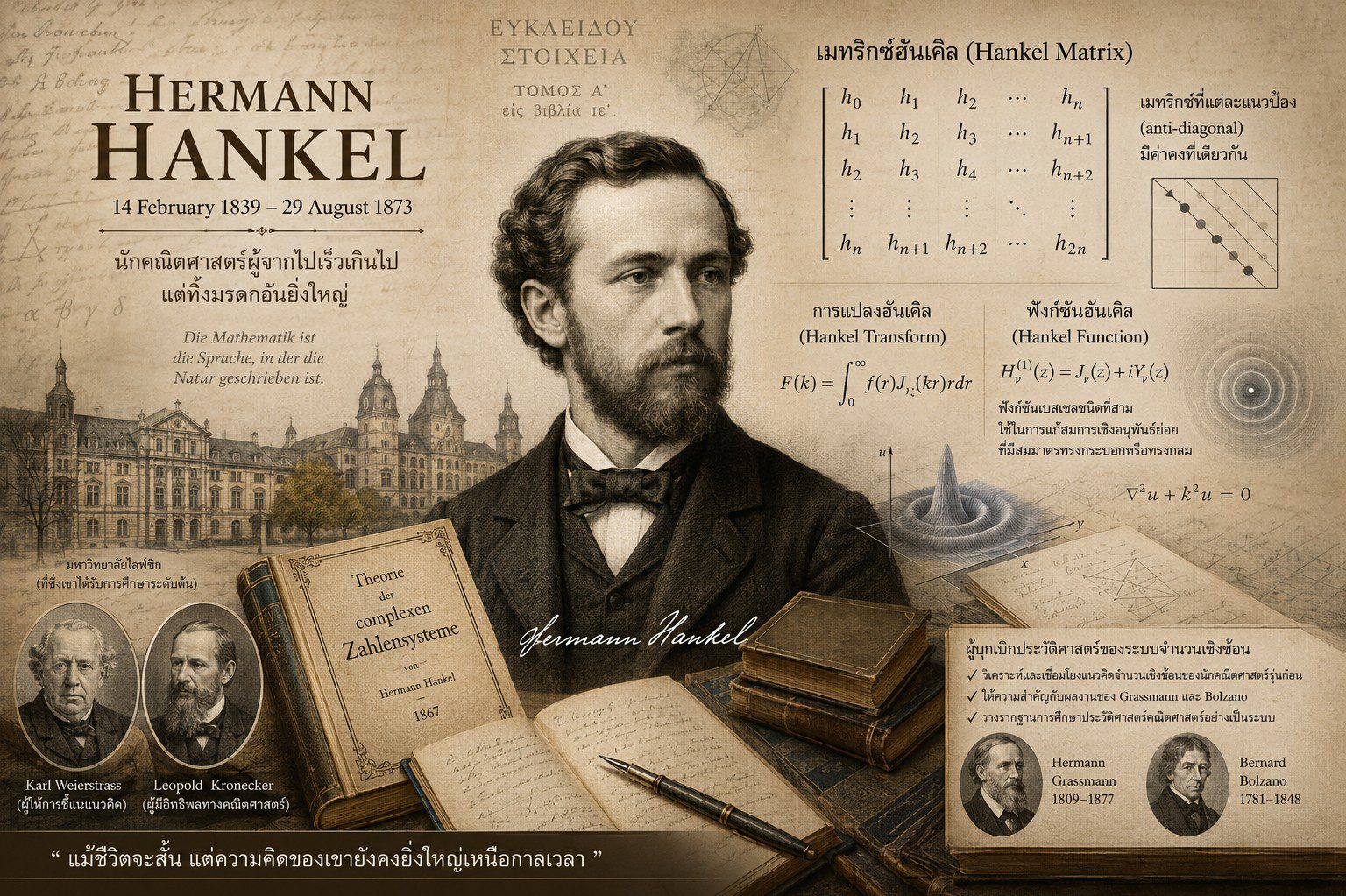
Hankel's most famous work today is the Hankel matrix, a special type of matrix where each anti-diagonal has the same constant value throughout. This type of matrix plays an important role in various fields, from control system theory and signal processing to time series analysis, and it continues to be a fundamental tool in computational linear algebra to this day.
In addition, he also originated the Hankel transform and the Hankel function, which is a type of third-kind Bessel function. The Hankel function is an essential tool for solving partial differential equations related to cylindrical or spherical symmetry and is widely used in mathematical physics, particularly in electromagnetic wave theory, acoustics, and quantum mechanics.
The pioneer of systematically developing the history of complex number systems
Apart from his work in mathematical analysis, Hankel also played a crucial role in systematically studying the history of complex number systems for the first time in his important book titled Theorie der complexen Zahlensysteme Published in 1867, he proposed a new framework for understanding complex numbers, starting from the refinement of George Peacock's principle of the 'permanence of formal laws,' and further developed it to encompass other advanced algebraic systems such as Möbius's barycentric calculus, parts of Hermann Grassmann's algebra, and William Rowan Hamilton's quaternions.
What is remarkable is that Hensel was one of the first mathematicians to recognize the importance of Hermann Grassmann's work, which at that time was not widely known in the mathematical community, and he was also someone who credited the significance of Bernard Bolzano's work on infinite series, which helped both mathematicians' works gain more recognition later on.
A knowledgeable historian of mathematics
With a profound knowledge of the Greek language, Hankel was able to study ancient Greek mathematical texts directly from the originals, which made his work in the history of mathematics particularly reliable and deep. His significant contributions in this field include writings on the history of mathematics in the classical and medieval periods, published in 1869 and 1874 (after his death).
Hermann Hankel passed away on August 29, 1873, in the city of Schramberg at the age of only 34. Although his life was shorter than it should have been, his diverse works, including the Hankel matrix, Hankel functions, and contributions to the history of mathematics, remain valuable legacies and continue to be used in the fields of mathematics and physics worldwide to this day, more than 150 years after his passing.