Irving Segal: The guy who connected math to the foundations of quantum physics
On August 30, 1998, in Lexington, Massachusetts, Irving Ezra Segal, an American mathematician, suddenly passed away while taking an evening walk near his home at the age of 79 from arteriosclerosis, just a few weeks before his 80th birthday. He left behind work that laid an important foundation for functional analysis and axiomatic quantum field theory.
A genius facing obstacles from racial prejudice
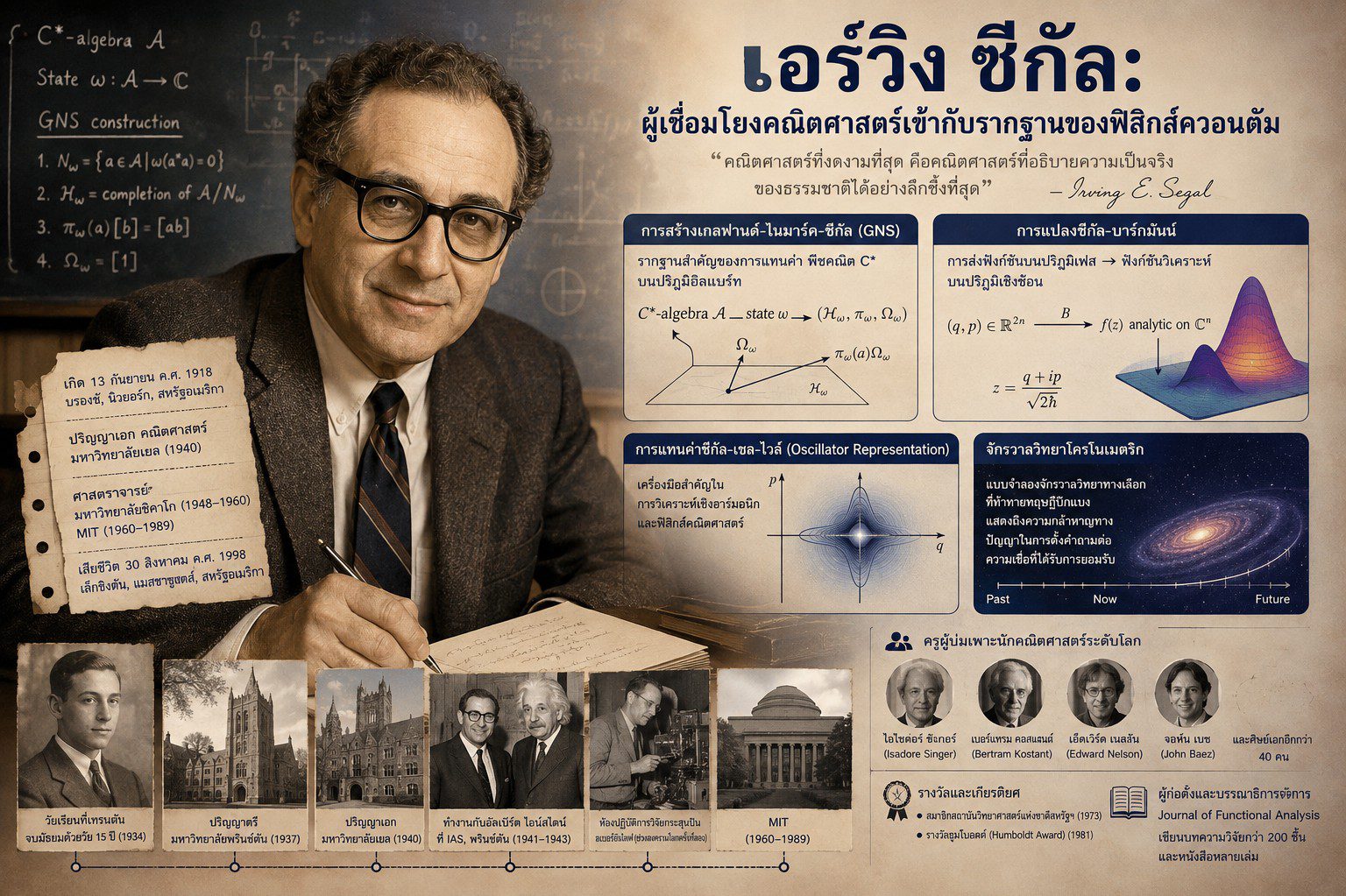
Sigal was born on September 13, 1918, in the Bronx, New York, into a Jewish family. His parents were Aaron Sigal and Fanny Weinstein. Although he was born in the Bronx, he grew up and went to high school in Trenton, New Jersey. He graduated from Trenton High School in 1934 at just 15 years old and started studying at Princeton University that same year. Even though it was believed that Princeton at the time had a limited quota for Jewish students, Sigal faced these challenges head-on and graduated with highest honors in 1937, also receiving the George B. Covington Prize in Mathematics. There's an interesting story that a fellow student once offered to pay Sigal to take an exam for him, but Sigal refused without hesitation, showing his steadfast honesty from a young age.
He went on to pursue his PhD at Yale University under the supervision of Einar Hille, who advised Seigal to study the ideal theory of Laplace-Stieltjes transforms, building on the research he had done with Tamarkin. He received his doctorate in 1940 at the young age of just 22.
From War to the Foundations of Quantum Field Theory
After graduation, Seigal taught at Harvard University in 1941 before joining the Institute for Advanced Study at Princeton as a research fellow with a Guggenheim fellowship from 1941 to 1943, where he worked under the supervision of Albert Einstein. He then served in the army at the Ordnance Research Laboratory at the Aberdeen Proving Ground during World War II, before returning to work at the Institute for Advanced Study again from 1945 to 1948.
In 1948, Segal got a professorship at the University of Chicago, which was when he started developing the most important work of his life. That was his effort to create a rigorous foundation for axiomatic quantum field theory. His most famous work in this area is the Gelfand-Naimark-Segal construction, or GNS construction as it’s known, which is the standard method for representing C* algebras on Hilbert spaces. This technique became a key foundation for the modern algebraic approach to studying quantum mechanics and field theory.
Segal–Bargmann Transform and Its Mathematical Physics Heritage
Another important work of Segal is the Segal-Bargmann transform, which maps functions on phase space to analytic functions on complex space. This technique is widely used in quantum optics, coherent states, and deformation quantization. He also developed the Segal-Shale-Weil representation, also known as the oscillator representation, which is an important tool in harmonic analysis and mathematical physics.
In 1960, Siegel moved to work at the Massachusetts Institute of Technology (MIT), where he spent 28 years until retiring in 1989 as an expert in functional analysis and harmonic analysis. At MIT, he played a key role in improving and elevating the undergraduate math curriculum.
A teacher who nurtures world-class mathematicians and cosmologists who challenge the mainstream
Throughout his career, Segal supervised up to 40 PhD students, including Isadore Singer, who developed the axiomatic quantum field theory and index theory, Bertram Kostant, Edward Nelson, and John Baez, known for their work in quantum field theory and higher category theory. Nelson once wrote in a tribute that Segal’s encouragement was incredibly strong while he was writing his dissertation, and that Segal not showing any support when results had no relevance beyond themselves was equally important.
Besides his work in pure mathematics, later in his career, Siegel also developed what he called chronometric cosmology, an alternative cosmological model that challenges the widely accepted Big Bang theory. Even though this idea was accepted by only a few astronomers, it showed Siegel's intellectual courage in questioning widely held beliefs.
Segal was elected as a member of the U.S. National Academy of Sciences in 1973 and received the Humboldt Award in 1981. He was the founder and managing editor of the Journal of Functional Analysis and wrote several books, along with more than 200 research papers in mathematics and physics. He was married three times and had four children. Irving Segal's academic legacy, especially the construction of GNS and the Segal–Bargmann transform, remains a fundamental tool that mathematical physicists around the world use every day to this day.