Haskell Curry: Father of Combinatory Logic and the Origin of the Haskell Programming Language Name
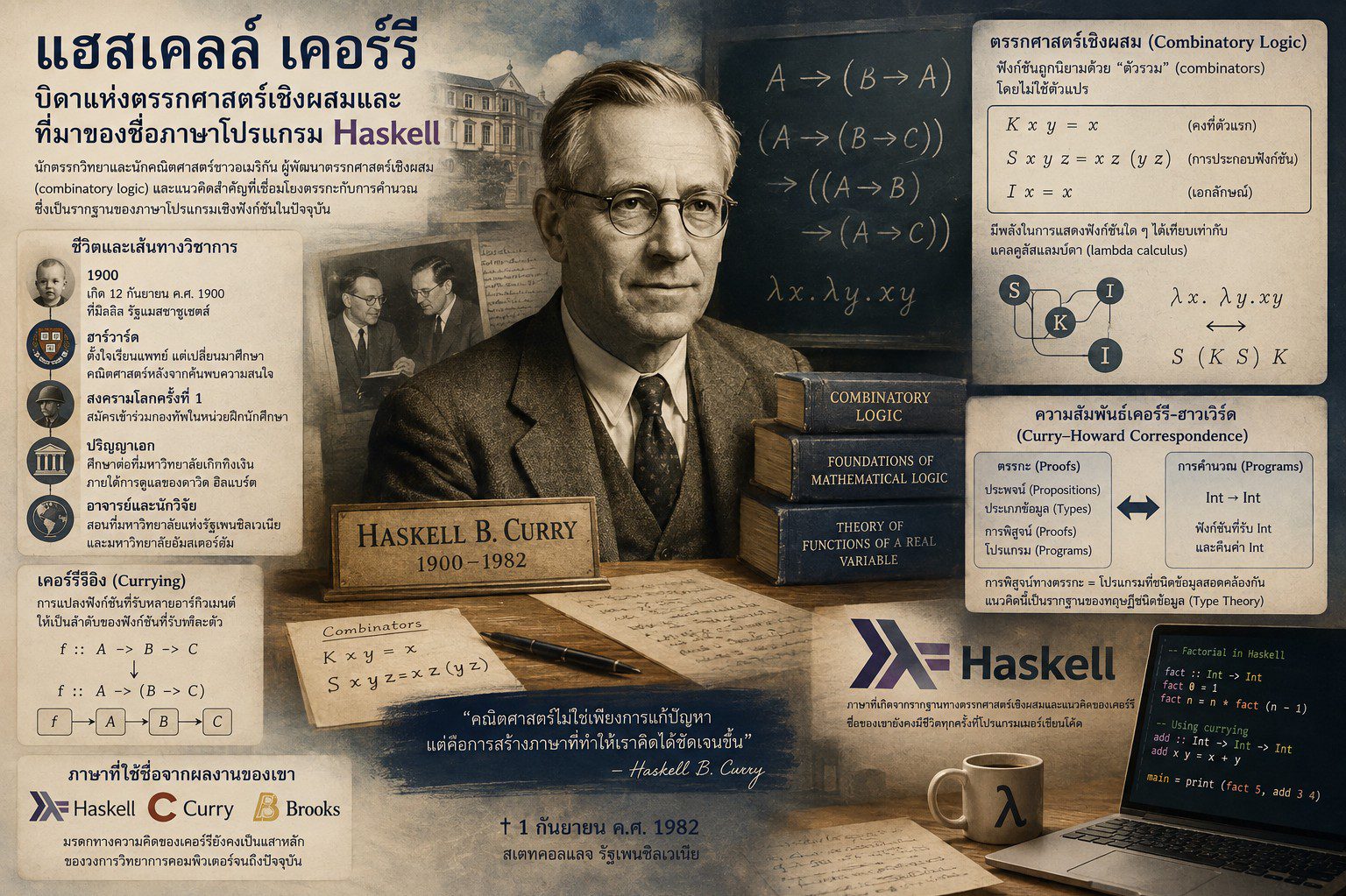
In the field of modern functional programming, there is the name of a mathematician that was used as the name of a famous programming language called Haskell. That is Haskell Brooks Curry, an American logician and mathematician, who passed away on September 1, 1982, in State College, Pennsylvania (the same day that Ludwig Bieberbach died in Germany).
Early life and academic path
Kerry was born on September 12, 1900, in Millis, Massachusetts. His father, Samuel Silas Curry, was the dean of the School of Expression in Boston, which later became Curry College. Kerry enrolled at Harvard University intending to study medicine, but after trying mathematics in his first year on the advice of his advisor, he performed so well that he changed his path to studying mathematics instead.
During World War I, Curry enlisted in the army as a member of the student training unit. After the war, he returned to his studies and received a doctoral degree from the University of Göttingen, Germany, under the supervision of David Hilbert, a legendary mathematician. Curry worked as a professor at Pennsylvania State University for a long time, and later also held a position at the University of Amsterdam.
Hybrid Logic: The Foundations of Functional Computation
Kerry's most important work is the development of the field called combinatory logic, which initially had its beginnings in the work of Moses Schönfinkel. However, Kerry further developed it into a complete system with widespread influence. Combinatory logic is a mathematical system that uses “combinators” instead of variables to define functions, without the need to explicitly refer to variables at all.
This concept was originally intended to serve as the foundation of a traditional symbolic logic system, but the original system was found to be self-contradictory (inconsistent). However, the consistent part of this system later became an important prototype for functional programming languages, which are languages that allow programs to be applied to and modify other programs. This system is fundamentally equivalent to Alonzo Church's lambda calculus.
Logical Connection with Computers: Curry-Howard Correspondence
One of the works that has profoundly influenced modern computer science is the concept later known as the Curry–Howard correspondence, which points out a deep connection between 'logical proofs' and 'computer programs.' That is, logical propositions can be viewed as data types in a programming language, and proving a proposition is equivalent to writing a program with the corresponding type. This concept has become a fundamental foundation of type theory in computer science and has influenced the design of programming languages and automated theorem proving systems today.
In addition, Curry is also known for the concept of 'currying,' which is a technique for transforming a function that takes multiple arguments into a sequence of functions that each take one argument at a time. This technique is widely used in modern functional programming languages, and although the concept does not entirely originate from Curry, it was named in his honor.
The legacy that still lives in programming language names
Due to his outstanding work in combinatory logic, which is a fundamental basis of functional programming languages, Curry's name has been used for three programming languages, including Haskell, which is a well-known pure functional programming language still widely used today, Brook, and Curry itself, which proves the profound influence of his research on the field of computer science.
Curry died on September 1, 1982, in State College at the age of 81. He left academic papers in the Pennsylvania State University library, and his intellectual legacy continues to live on every time a programmer writes code in a functional programming language today.