Oded Shramm: The connector of probability theory with statistical physics
Among contemporary mathematicians who have had a profound influence on the field of probability theory, one name stands out particularly for work that beautifully connects two branches of science: Oded Schramm, an Israeli-American mathematician who passed away on September 1, 2008, in a climbing accident near Snoqualmie Pass, Washington, USA, at the age of only 46.
Early life and academic path
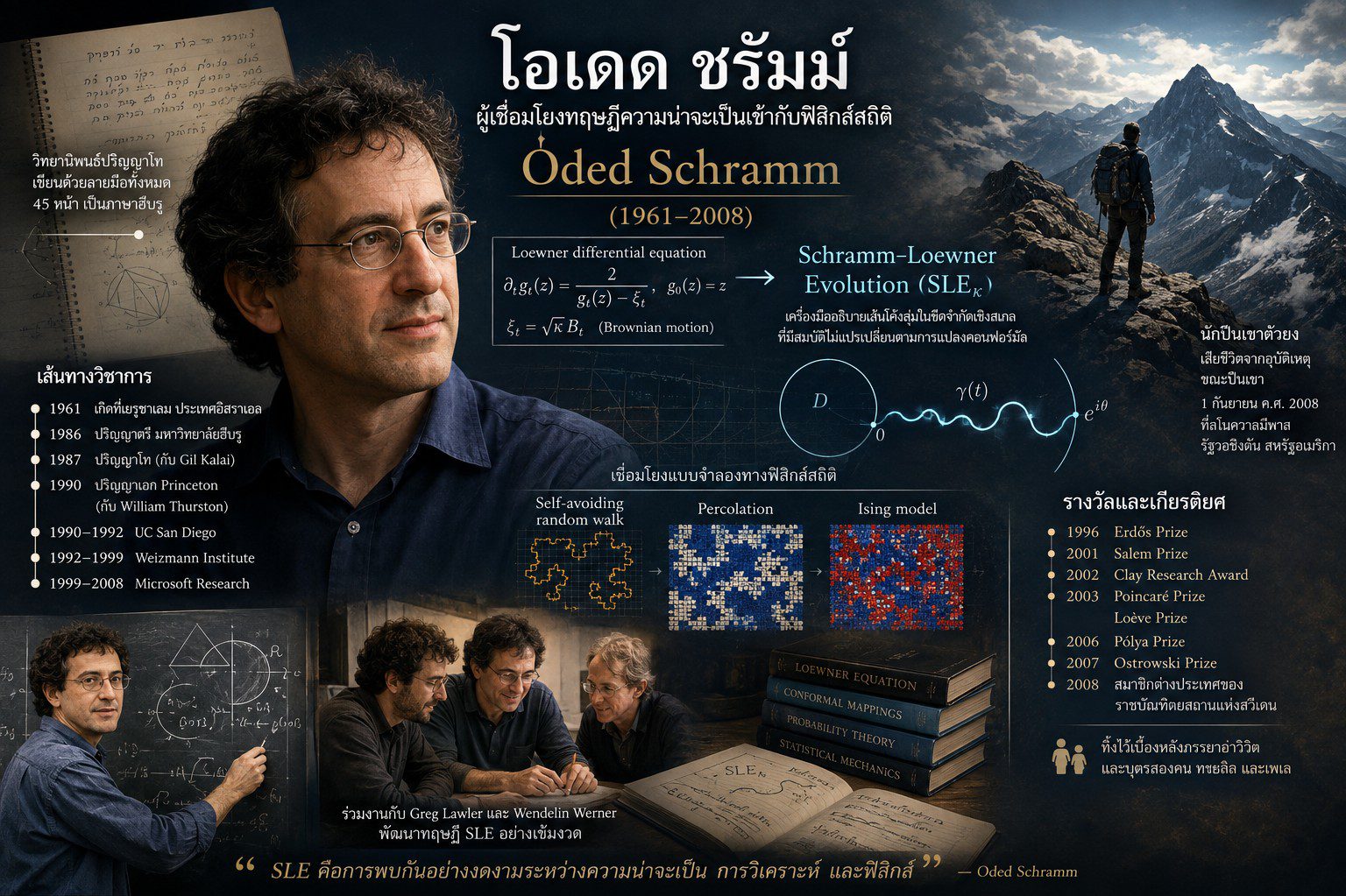
Schramm was born on December 10, 1961, in Jerusalem, Israel. His father, Michael Schramm, was a professor of biochemistry at the Hebrew University of Jerusalem. Schramm studied mathematics and computer science at the Hebrew University, earning a bachelor's degree in 1986 and a master's degree in 1987 under the supervision of the renowned mathematician Gil Kalai. His master's thesis on Borsuk's problem was handwritten, consisting of 45 pages in Hebrew, complete with illustrations and numerous footnotes.
Then Schramm went on to pursue a Ph.D. at Princeton University, USA, under the supervision of William Thurston, a legendary mathematician, where he wrote a thesis on circle packing and conformal mapping. In 1990, after working at the University of California, San Diego for two years, Schramm returned to Israel in 1992 to work at the Weizmann Institute in Rehovot, before in 1999 being recruited by Microsoft to work on pure mathematics research at Microsoft Research in Redmond, Washington.
The invention of Schramm-Loewner Evolution (SLE)
The work that made Schramm's name most recognized in the field of mathematics is the invention of the Schramm–Loewner evolution (SLE), originally called 'stochastic Loewner evolution,' in 2000. SLE is a mathematical tool that describes random curves that occur in the scaling limit of various models in statistical mechanics, such as the self-avoiding random walk and percolation.
The key idea of SLE is to combine the Loewner differential equation, a classical tool in complex analysis, with a Brownian motion stochastic process, allowing for an accurate description of the behavior of random curves that possess conformal invariance. This is an important property that physicists have observed in critical systems for a long time but lacked sufficiently rigorous mathematical tools to prove.
Impact on the field of mathematics and physics
The development of SLE is considered a revolution in understanding critical processes in two dimensions by connecting probability theory with analysis and topology in an unprecedented way. The joint research of Schramm with Greg Lawler and Wendelin Werner rigorously demonstrated the connection between SLE and various models in statistical physics, work that has been highly acclaimed in the field. Werner himself was awarded the Fields Medal in 2006 for work related to SLE.
Szemerédi himself also received many prestigious awards throughout his career, including the Erdős Prize in 1996, the Salem Prize in 2001, the Clay Research Award in 2002, the Poincaré Prize and the Loève Prize in 2003, the Pólya Prize in 2006, and the Ostrowski Prize in 2007. He was elected a foreign member of the Royal Swedish Academy of Sciences in 2008, the same year he passed away.
The sudden departure
Schramm was an avid mountaineer. He died on September 1, 2008, from a fall while climbing Guye Peak, north of Snoqualmie Pass, Washington. He was climbing alone, and when he did not return as scheduled, his wife reported him missing, and his body was found the next morning. Schramm left behind his wife, Avivit, and two children, Tselil and Pele (Tselil later became an assistant professor of statistics at Stanford University).
Academic heritage
Although Schramm died at the young age of 46, his work has completely transformed the field of probability theory. SLE remains an essential tool that mathematicians and physicists around the world use to study critical phenomena in two-dimensional systems up to the present day, and Schramm himself is widely recognized as one of the most influential probabilists of his era.