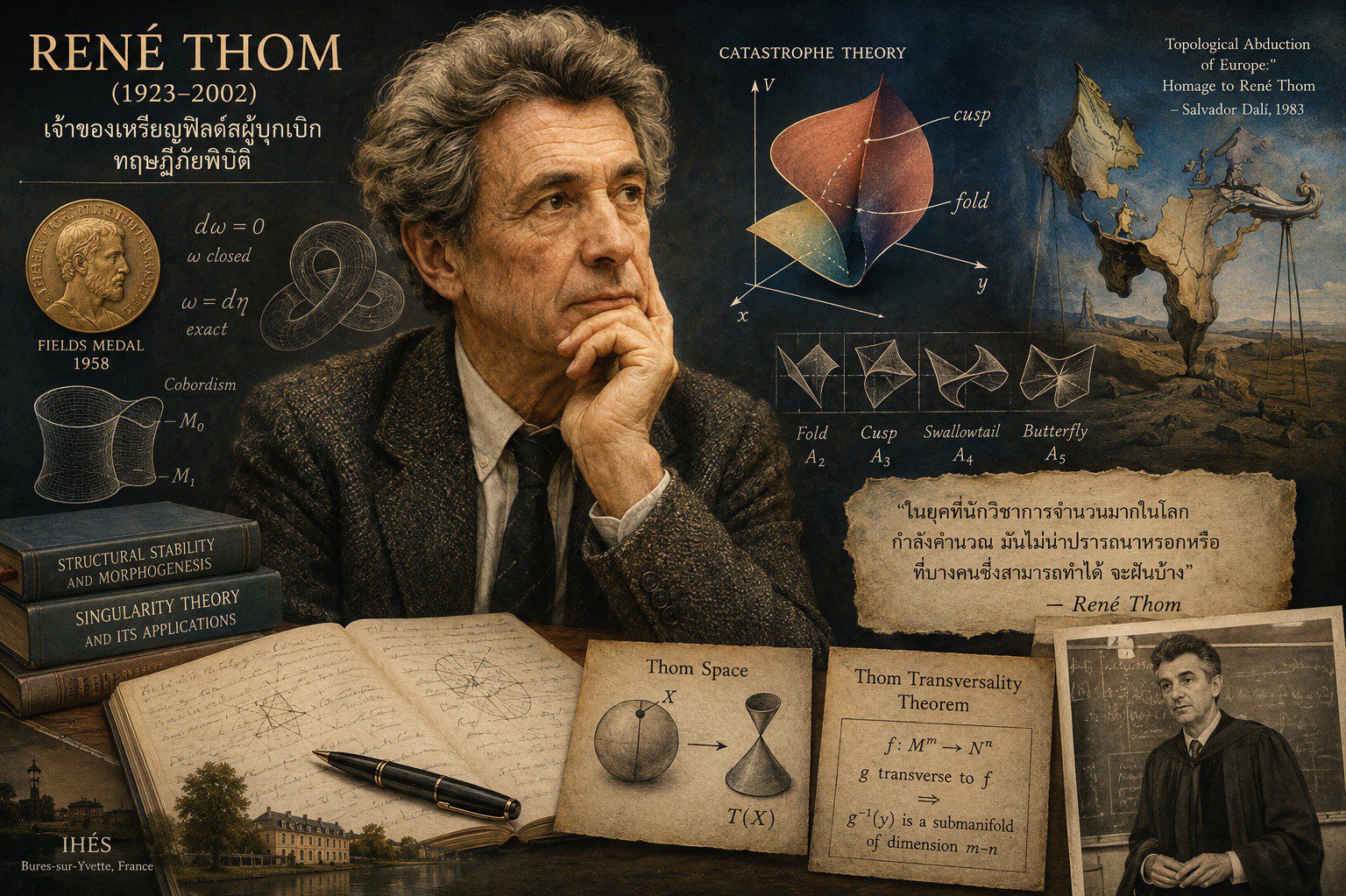
René Thom: Fields Medalist and Pioneer of Catastrophe Theory
Among 20th-century French mathematicians, there is one name that stands out both for deep work in differential topology and for theories that caused a sensation across academic fields beyond mathematics. That is René Frédéric Thom, a French mathematician, born on September 2, 1923, in Montbéliard, near the Swiss border, France.
Early life amid war
Tom grew up in a family that was not very wealthy. His father owned a grocery store in the town of Montbéliard but was well-educated, had a deep knowledge of Latin, and wrote poetry. Tom showed academic talent from a young age, received a scholarship to the elementary school in his hometown, and continued his studies at Collège Cuvier before obtaining a high school diploma in basic mathematics from the city of Besançon in 1940.
Tom's life was greatly disturbed by World War II. When the German army invaded and occupied France, his parents sent him and his older brother to evacuate to the south for safety. The two traveled to Switzerland before returning to France again. Tom moved to Lyon to continue his studies and received a high school diploma in philosophy in 1941. In the same year, he enrolled at Lycée Saint-Louis in Paris and tried to enter the École Normale Supérieure, succeeding on his second attempt in 1943.
The Path to Differential Topology
Tom studied at École Normale Supérieure until 1946 and was deeply influenced by Henri Cartan, a great mathematician and one of the founders of the Bourbaki group. After that, Tom moved to Strasbourg to continue his studies under Cartan's supervision, and in 1951 he earned a doctorate with a thesis entitled 'Fibre Spaces on Spheres and Steenrod Squares,' which was work in algebraic topology. Later, inspired by Charles Ehresmann, Tom turned his attention more to geometric approaches.
The Fields Medal for work in algebraic topology
In 1958, Tom received the Fields Medal, considered the highest honor in mathematics, equivalent to the Nobel Prize, for his significant work in differential topology, particularly expanding the work of Soviet mathematicians such as Vladimir Rokhlin and Lev Pontryagin regarding the concept of cobordism. Tom also co-founded two new branches of mathematics with Hassler Whitney: differential topology and singularity theory, which are important tools in studying the intersection points of manifolds in dimensions higher than the familiar three or four dimensions.
Disaster Theory: Famous Work Outside the Field of Mathematics
Although he received the Fields Medal for his work in topology, the work that made Tom’s name widely known was catastrophe theory, which he published in the book “Structural Stability and Morphogenesis” in 1972. This theory is a mathematical framework used to explain how continuous actions can produce discontinuous results, using functions on surfaces with folds and cusps.
This theory created a great sensation in academic circles because many analysts tried to apply it in various fields beyond mathematics, such as biology, social sciences, and even finance. Although the results of its application in some fields remain controversial and are not consistently accepted, catastrophe theory has become a recognized area of mathematical research and has had a significant impact on the development of new concepts, particularly chaos theory. Later, Thom's work also inspired artists like Salvador Dalí to paint “Topological Abduction of Europe: Homage to René Thom” in 1983 in his honor.
Interest in philosophy in later life
In the later stages of his career, Tom increasingly turned his attention to philosophy and linguistics. He often remarked that he was more interested in the deep philosophical meaning behind mathematics than in the technical rigor that his colleagues adhered to. The final sentence in his book 'Structural Stability and Morphogenesis,' which states, 'In an age when many scholars in the world are calculating, would it not be desirable for someone who can to dream a little?' reflects his profound philosophical ideas very well.
Thom worked at the University of Grenoble and Strasbourg before joining the Institut des Hautes Études Scientifiques (IHÉS) in Bures-sur-Yvette in 1964. He passed away on October 25, 2002, in Bures-sur-Yvette at the age of 79.
Academic heritage
René Thom left an academic legacy covering both algebraic and differential topology, singularity theory, and catastrophe theory that went beyond the boundaries of pure mathematics to inspire scholars in other fields around the world. His name still appears in many important concepts, such as Thom space and Thom's transversality theorem, which remain key tools in the study of topology and differential geometry up to the present day.