Maurice Fréchet: Pioneer of Metric Spaces and the Foundations of Modern Topology
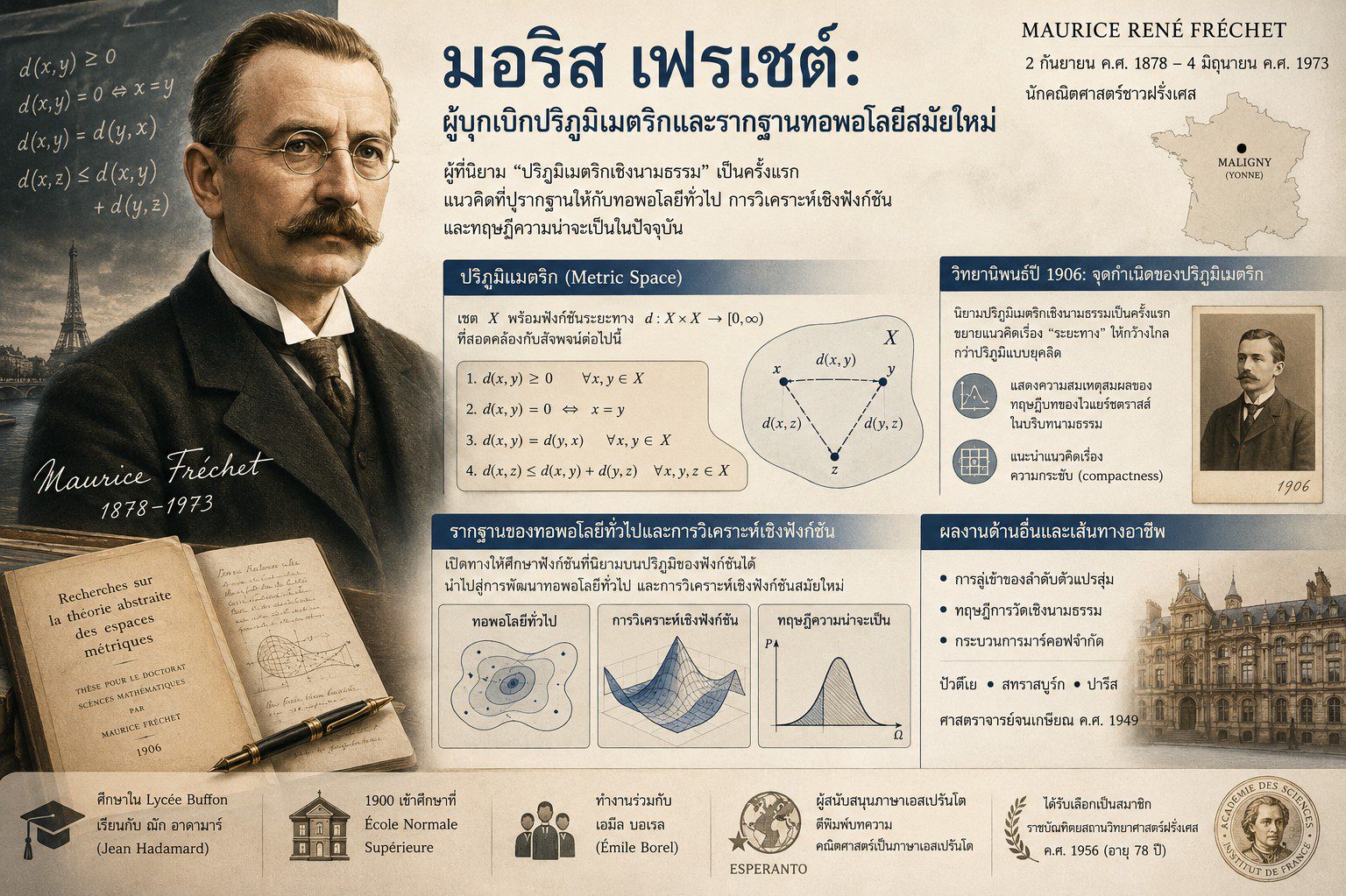
Among the most fundamental concepts of modern mathematical analysis and topology, there is one concept on which almost every branch of mathematical analysis relies as a foundation. That is the 'metric space,' which was first defined by Maurice René Fréchet, a French mathematician, born on September 2, 1878, in Maligny, Yonne, France.
Early life and academic path
Among the most fundamental concepts of modern mathematical analysis and topology, there is one concept on which almost every branch of mathematical analysis relies as a foundation. That is the 'metric space,' which was first defined by Maurice René Fréchet, a French mathematician, born on September 2, 1878, in Maligny, Yonne, France. ...
Fréchet studied at Lycée Buffon in Paris, where he was fortunate to study under Jacques Hadamard, a world-renowned mathematician, before Hadamard moved to Bordeaux in 1894. In 1900, Fréchet was admitted to the École Normale Supérieure, one of the most prestigious higher education institutions in France, and later worked with Émile Borel, a mathematician who was only seven years older than him but had enough experience to become his important advisor.
Thesis of 1906: The Origin of Metric Spaces
In 1906, Fréchet completed his doctoral degree with a thesis that was acclaimed as one of the most outstanding French mathematics theses of that era, with Jacques Hadamard as his advisor. In this thesis, Fréchet defined the concept of an "abstract metric space" for the first time, which was an extension of the concept of "distance" to encompass more than the familiar Euclidean spaces.
Fréchet's idea is to view a space as merely a set of points with certain relations between those points, using a metric function that satisfies certain axioms, which does not necessarily have to be a traditional geometric space. In this very thesis, he also demonstrated the validity of Weierstrass’s theorem in the context of abstract spaces and introduced the concept of compactness, which is one of the most important concepts in modern topology.
Foundations of General Topology and Functional Analysis
The definition of a metric space by Fréchet is considered a significant step that led to the development of the fields of general topology and modern functional analysis. Previously, mathematicians usually studied functions defined only on Euclidean spaces, but Fréchet's concept paved the way for studying functionals defined on spaces of functions themselves, which was a very important conceptual leap.
Even in the early period, highly abstract concepts like this were not immediately accepted by the mathematics community, which had just begun to accept topology in a more concrete form. However, later on, Fréchet's ideas proved to be immensely valuable in solving concrete problems that had long troubled mathematicians. Today, metric spaces have become an indispensable foundational structure in teaching advanced mathematical analysis worldwide, and they represent an important first step leading to the broader concept of topological spaces in later times.
Other works and career path
Apart from metric spaces, Fréchet also made significant contributions to probability theory, particularly the study of the convergence of sequences of random variables, in which he was one of the pioneers in systematically applying abstract measure theory in this context. He also made important contributions in finite Markov processes. He held professorships at the University of Poitiers, Strasbourg, and eventually in Paris, where he worked until his retirement in 1949.
It is noteworthy that although Fréchet's work was highly influential, he was not fully recognized in his native France. Despite being nominated several times to the French Academy of Sciences, he was not elected as a member until the age of 78 in 1956. Fréchet was also known as an enthusiastic supporter of the international language Esperanto and had published mathematical articles in Esperanto as well.
Frechet passed away on June 4, 1973, in Paris at the age of 94, leaving behind a legacy of thought that is a fundamental foundation of all modern mathematical analysis, whether it is general topology, functional analysis, or probability theory.