James Joseph Sylvester: The mathematician who named the 'matrix'
If you have ever studied linear algebra and are familiar with the word 'matrix,' few people know that this term was coined by an English mathematician over 170 years ago. That man was James Joseph Sylvester, one of the thinkers who laid the important foundations for modern mathematics, and also a prolific 'terminologist' who left mathematical terms for us to use to this day.
Early life and obstacles from religious prejudice
Sylvester was born on September 3, 1814, in London, England, into a Jewish family. He originally used the surname 'Joseph' from his father but later changed it to 'Sylvester' before pursuing higher education at the university level.
He showed talent in mathematics from a young age and continued his studies at St John’s College, University of Cambridge, in 1837. He ranked second in Cambridge’s famous Mathematical Tripos exams but did not receive a degree from the university because at that time, those who wanted to receive a degree had to declare their acceptance of the 39 Articles of the Church of England, which Sylvester, being Jewish, refused to do. He had to wait to receive his degree from Trinity College in Dublin instead, where there were no such religious restrictions.
Religious prejudice continued to haunt his career for many more years, including being excluded from academic positions and various awards at Cambridge.
The bumpy road to a professorship
Sylvester began as a professor of natural philosophy at University College London before crossing the Atlantic to accept a position as a professor of mathematics at the University of Virginia, USA, in 1841. However, he held this position for only a few months before having to resign after an incident involving a clash with a student in class, which led Sylvester to decide to flee back to New York to live with his brother who resided there.
At one point, he even turned to work as an actuary together with his mathematician friend, Arthur Cayley, which became the beginning of one of the most important academic collaborations in the history of mathematics.
Collaboration with Cayley and the invariant theory
Sylvester and Cayley together laid the foundation of invariant theory, which is the study of properties of equations or shapes that do not change even when the coordinates are transformed, such as by rotation or translation of axes. Both are honored as co-founders of this field, which later became an important foundation for modern algebra and also influenced theoretical physics in later times.
In addition, Sylvester also made significant contributions to number theory, particularly in the area of partitioning of integers and Diophantine analysis, which involves finding integer solutions to algebraic equations.
Term creator in the field of mathematics
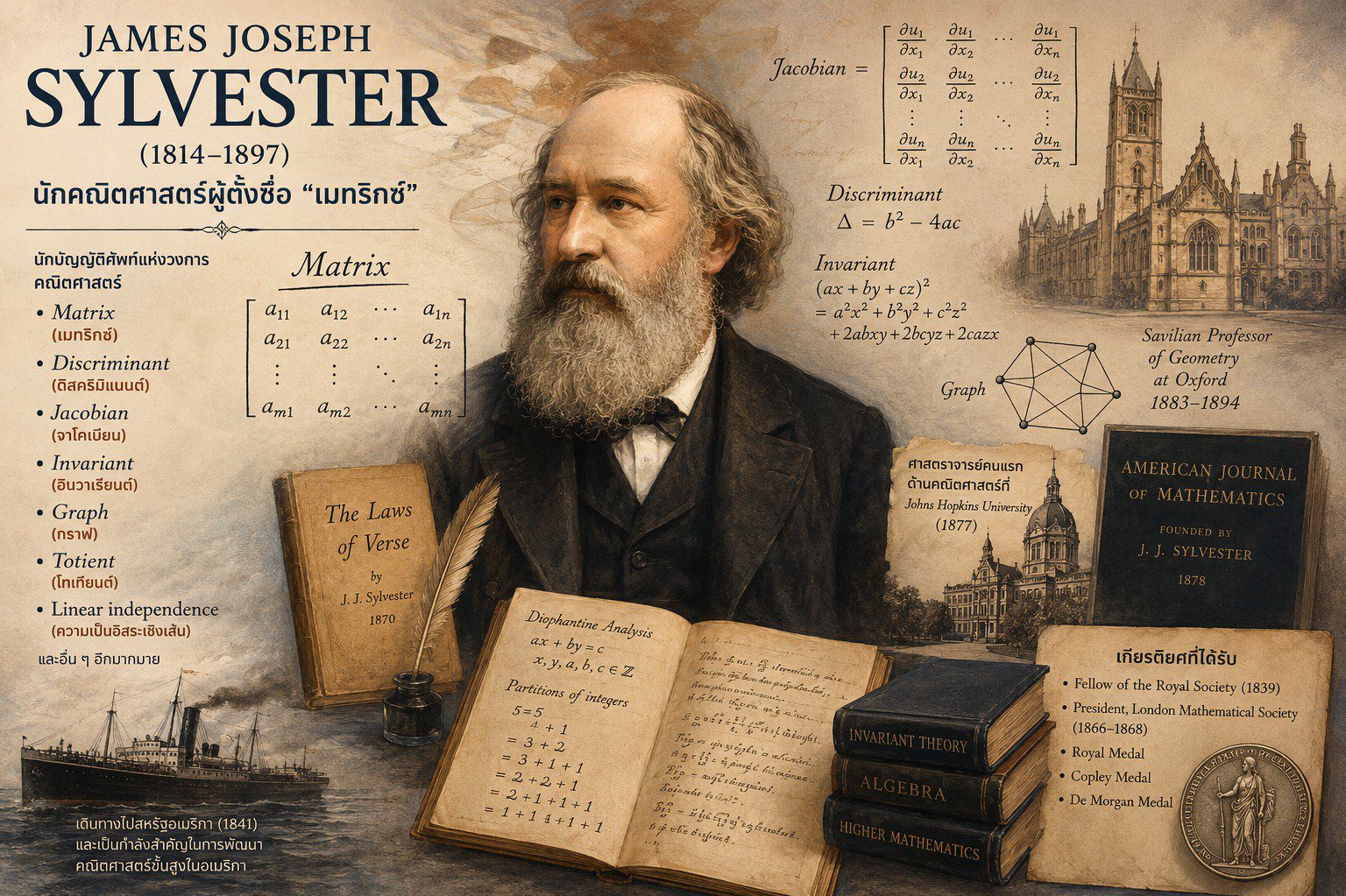
The highlight that makes Sylvester particularly memorable is his ability and pride in inventing new terms to describe mathematical concepts. Many of the terms he coined are still widely used today, such as
- Matrix — a table of numbers used to represent a system of linear equations. Currently, it is one of the most fundamental concepts in linear algebra.
- Discriminant — a value used to indicate the nature of the solution in a polynomial equation
- Jacobian — a matrix of partial derivatives used in multivariable calculus
- Invariant, Graph (in the combinatorial sense), Totient, Linear independence, and many more
Although some words he coined are not commonly used today, the main words that remain are sufficient to demonstrate his influence on modern mathematical language.
Pioneer in the field of American mathematics
In 1877, Sylvester returned to the United States once again to take the position of the first professor of mathematics at the newly established Johns Hopkins University in Baltimore. It was here that he created a major impact on the field of higher mathematics in America, and in 1878 he founded the American Journal of Mathematics, the first mathematics journal in the United States, which is still published to this day.
The twilight of one's life
In 1883, Sylvester returned to England to take the position of Savilian Professor of Geometry at the University of Oxford and held this position until 1894, when health problems and deteriorating eyesight forced him to retire from teaching. He spent his later years in London and died on March 15, 1897, at the age of 82.
Throughout his working life, Sylvester received many honors, including being a member of the Royal Society since 1839, serving as the second president of the London Mathematical Society (1866–1868), as well as the prestigious Royal Medal, Copley Medal, and De Morgan Medal.
A legacy that remains.
Although Sylvester's published works amount to several hundred pieces, what sets him apart from other mathematicians of his time is his brilliant imagination and his boldness to think outside the box. He worked more with inspiration than meticulousness in proof, which sometimes made it difficult to trace the origins of conclusions in his work, but it always served as a driving force for new ideas.
Aside from mathematics, Sylvester is also known as a poet and has published a book. The Laws of Verse In the year 1870, which reflects the diverse interests of this man
Nowadays, whenever students, university students, or engineers around the world open a linear algebra textbook and write the word 'matrix' on paper, they are using the linguistic legacy that James Joseph Sylvester left to the world of mathematics more than a century ago.