Charlotte Angus Scott: The advocate for the first generation of female PhD mathematicians in America
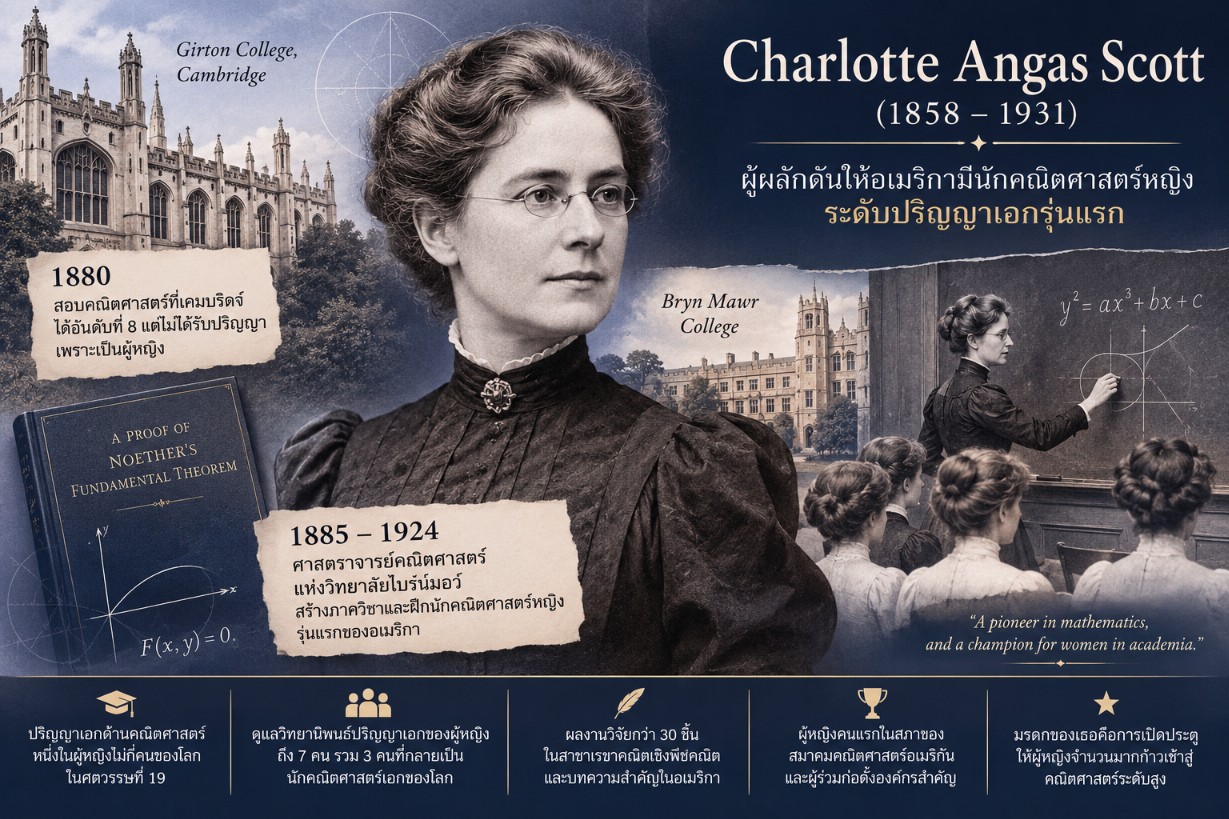
In 1880, a young woman took the mathematics exam at Cambridge and ranked 8th, but did not receive the position or degree that should have followed, simply because she was a woman. Five years later, she crossed the Atlantic to become the only mathematician at a new college in Pennsylvania and established a department that transformed mathematics education for women in America. She was Charlotte Angas Scott, an English mathematician working in the United States, born on June 8, 1858, in Lincoln, England, and passed away on November 10, 1931, at her home in Cambridge at the age of 73.
Cambridge, 1880
Scott enrolled at Girton College, a women's college at Cambridge, in 1876. At that time, women were not yet awarded degrees by the University of Cambridge. However, in 1880, she was granted special permission to sit for the Mathematical Tripos, which was the university's most difficult mathematics examination, and she scored at a level equivalent to 8th place. But her name was not officially ranked, and she did not receive the title “Wrangler” that high-ranking candidates were supposed to get. It is said that at the announcement ceremony, a male student shouted in praise, 'Scott of Girton,' according to accounts cited by several biographers. Her achievements, along with those of many other women, contributed to the university later changing the rules regarding this examination.
When she was unable to receive a degree at Cambridge, Scott continued her studies at the University of London, which allowed women to take exams, and obtained a degree in science, with Arthur Cayley, a great mathematician, as her advisor. She was one of the few women in the world at that time to have a doctorate in mathematics.
From Cambridge to Brynmawr
In 1885, Bryn Mawr College reopened in Pennsylvania with the aim of providing the highest level of education for women, including graduate studies. The college hired Scott as the head of the mathematics department on the recommendation of Cayley, partly because she was one of the few women in the world with a doctorate in this field, and she was the only mathematician at the college initially. She became a full professor in 1888 and led the department continuously until her retirement in 1924. In April 1922, alumni held a celebration for the 37th anniversary of her being the head of the department.
She was strict about the academic standards for female students, writing to the college president with a firm determination that standards should not be lowered for women, and she founded the Mathematics Journal Club at Bryn Mawr as a meeting place for doctoral students.
The first generation female mathematician creator
Under the supervision of Scott Byrne, Mowgli became a center for women who wanted a PhD in mathematics quickly. She supervised the doctoral theses of seven women, including Ruth Gentry (1894), Ada Isabel Maddison (1896), Virginia Ragsdale (1906), and Louise D. Cummings, according to one source. Among the women who earned a PhD in mathematics in the 19th century, fewer than ten in the world, three were her students.
When she retired in 1924, she stayed at Bryn Mawr for another year to help the last doctoral student finish his dissertation before returning to Cambridge.
Research on algebraic curves
Scott was an algebraic geometer. She studied plane algebraic curves, base points, and transformations of these curves, which were major topics in algebraic geometry in the late 19th century and the Cayley era. Her work includes over 30 articles in journals worldwide, including an analytic geometry book that received excellent reviews from the American Mathematical Society in 1896.
Her article on a proof of Noether’s Fundamental Theorem is often regarded as the first mathematics paper written in America and seriously recognized in Europe. The theorem was the work of Max Noether, who was the father of Emmy Noether, in algebraic geometry.
Roles in Institutions and Teaching
Scott played an important role in the American Mathematical Society. She was the first woman to sit on the first Council of the American Mathematical Society (AMS) in 1894 and was a co-editor of the American Journal of Mathematics. She also helped establish the College Entrance Examination Board and served as the chief examiner for mathematics for two years.
She began losing her hearing at around the age of thirty, eventually becoming almost completely deaf later on. However, she continued to teach excellently. When students asked questions, graduate student assistants were present to help listen and answer doubts. She also trained senior students to help teach juniors, which was a method that made her department highly efficient despite having few teachers.
The twilight of one's life
After retiring, Scott moved back to Cambridge, England, and passed away at home on November 10, 1931. She was buried in the Ascension Parish Burial Ground in Cambridge, in the grave of Elisa Nevin, her relative, which has a memorial plaque noting that she entered Girton in 1876 and was a Wrangler in the Mathematical Tripos in 1880.
Inheritance
Charlotte Angus Scott was not only an outstanding mathematician, she was also the creator of a system that allowed many women to enter higher-level mathematics at a time when most doors were still closed. Many of her students went on to become professors at colleges across America, continuing the standards she set, and her name is still remembered in the history of women in mathematics worldwide.