Heinz Prüfer: The mathematician who gave a code to every tree with a sequence of numbers
Imagine a tree in graph theory, which is a network of points and lines without cycles, such as a computer network diagram. If we want to draw a tree with five points using only three numbers, is it possible? The German mathematician who answered “yes” and proved it elegantly was Heinz Prüfer, born on November 10, 1896, in Wilhelmshaven, Germany, and died on April 7, 1934, in Münster at the age of only 37 from lung cancer.
Early life and education
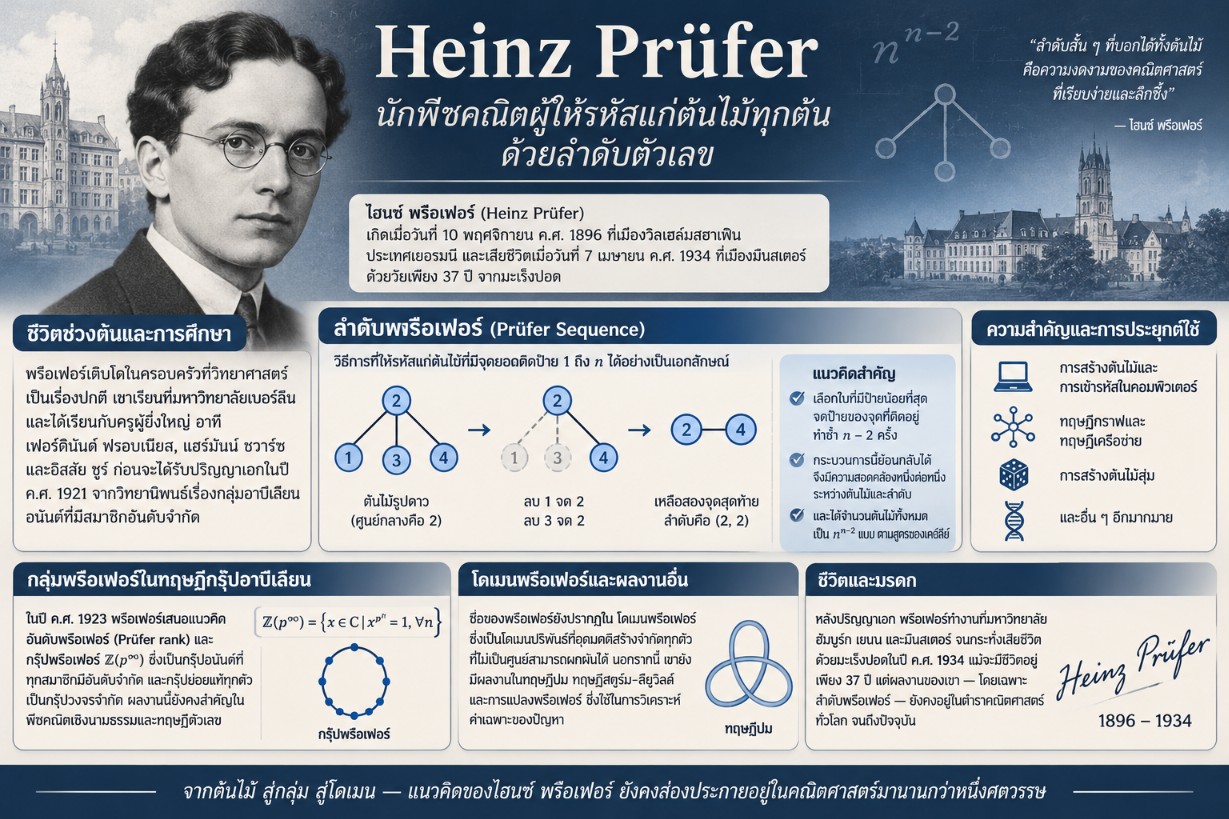
Ernst Paul Heinz Prüfer grew up in a family where science was a normal part of daily life. The city of Wilhelmshaven, where he was born, is a port city on the North Sea founded in 1853. He attended high school in Berlin-Schlendorf and entered the University of Berlin in 1915, which at that time was a center of German algebra. He studied with great teachers including Ferdinand Frobenius, who taught him the Dedekind way of thinking, which made him fascinated with abstract algebra, Hermann Schwarz, Paul Koebe, and Issai Schur.
During World War I, he was conscripted to work in the Prussian map surveying unit (Königlich Preussische Landesaufnahme) between 1917-1918, and he received his doctorate on April 28, 1921, under the supervision of Schur, with a thesis on infinite Abelian groups with a finite number of generators.
Perfume sequence in the year 1918
His most well-known work occurred while he was still a student. In a short article in 1918 in the journal Archiv der Mathematik und Physik on a new proof of a theorem about permutations, he provided a sharp proof of Cayley’s formula, which states that the number of labeled trees with n vertices is n to the power of n − 2.
His method is the Prüfer sequence for a tree with vertices labeled 1 to n. Repeat the following: choose the leaf (a vertex with only one edge) with the smallest label, record the label of the vertex it is connected to, then remove that leaf. Repeat this n − 2 times. Two vertices will remain at the end, and the sequence that was recorded is the code of the tree. For example, a star-shaped tree with 4 vertices where vertex 2 is the center has leaves 1, 3, and 4. Remove leaf 1 and record 2, remove leaf 3 and record 2, leaving vertices 2 and 4. The sequence is (2, 2). For a line-shaped tree 1-2-3-4, the sequence is (2, 3).
The beauty is that this process is always reversible. Every sequence of length n − 2 using the numbers 1 to n corresponds to exactly one tree. Therefore, there is a one-to-one correspondence between labeled trees and sequences, and since there are n^(n−2) sequences, there are also n^(n−2) trees. Besides providing a proof, this method is also a way to store and construct trees in computing, used in graph theory, network theory, random tree generation, and tree encoding in genetic algorithms.
Prufer group in abelian group theory
On the other hand, Prüfer was one of the leaders of the theory of infinite Abelian groups. In his 1923 work on the decomposition of countable primary Abelian groups, he extended the existing theory applicable to finite groups to cover groups with infinitely many elements and introduced the concept of the Prüfer rank. Moreover, he classified which types of countable primary groups could be decomposed as a direct sum of cyclic groups and provided a counterexample showing that the condition was not sufficient. This example is what is now called the Prüfer group, denoted by ℤ(p^∞), which is the group consisting of p^n-th roots of unity for all n. It is an infinite group in which every element has finite order, and every proper subgroup is a finite cyclic group. Today, Prüfer groups appear in abstract algebra, topology, and p-adic number theory, particularly in the decomposition of divisible groups and in the Pontryagin duality theory.
He wrote an article on the theory of abelian groups in two parts in 1924-1925 and emphasized that all results apply to modules over any principal ideal domain.
Domains, preferences, and other tasks
Prüfer's name also appears in Prüfer domain, which is an integral domain where every finitely generated ideal that is non-zero is invertible. This concept is a generalization of Dedekind domains and serves as a model for divisor theory in commutative algebra. In addition, he also worked on algebraic numbers, knot theory, and Sturm-Liouville theory, with his transformation known as the Prüfer transformation, used in the analysis of eigenvalues of problems. His name also appears in the Prüfer manifold in topology.
Occupation
After earning his doctorate, Pfeiffer worked at the University of Hamburg between 1921-1923 and at the University of Jena between 1923-1927, where he worked with Köber and obtained a permanent position. In 1927, he moved to the University of Münster and worked there until his death. Benno Hesselbach was one of his doctoral students. He was married but had no children, and he died of lung cancer in 1934.
The book on projective geometry (Projektive Geometrie), compiled from his lecture notes in Münster by Gustav Fleddermann and Gottfried Köthe, was published posthumously in 1935.
Inheritance
Heinz Prüfer was born on November 10, 1896, and died at the age of 37. However, the three concepts that bear his name — sequence, group, and domain — still remain in textbooks across various fields, from graph theory that computer science students study in their first year to abelian group theory and permutation algebra at the graduate level. The results he wrote on a few pages at the age of 21 are still considered some of the most beautiful proofs in combinatorics.