Andrei Bolibrukh: The Belief-Breaker of 80 Years About Hilbert's 21st Problem
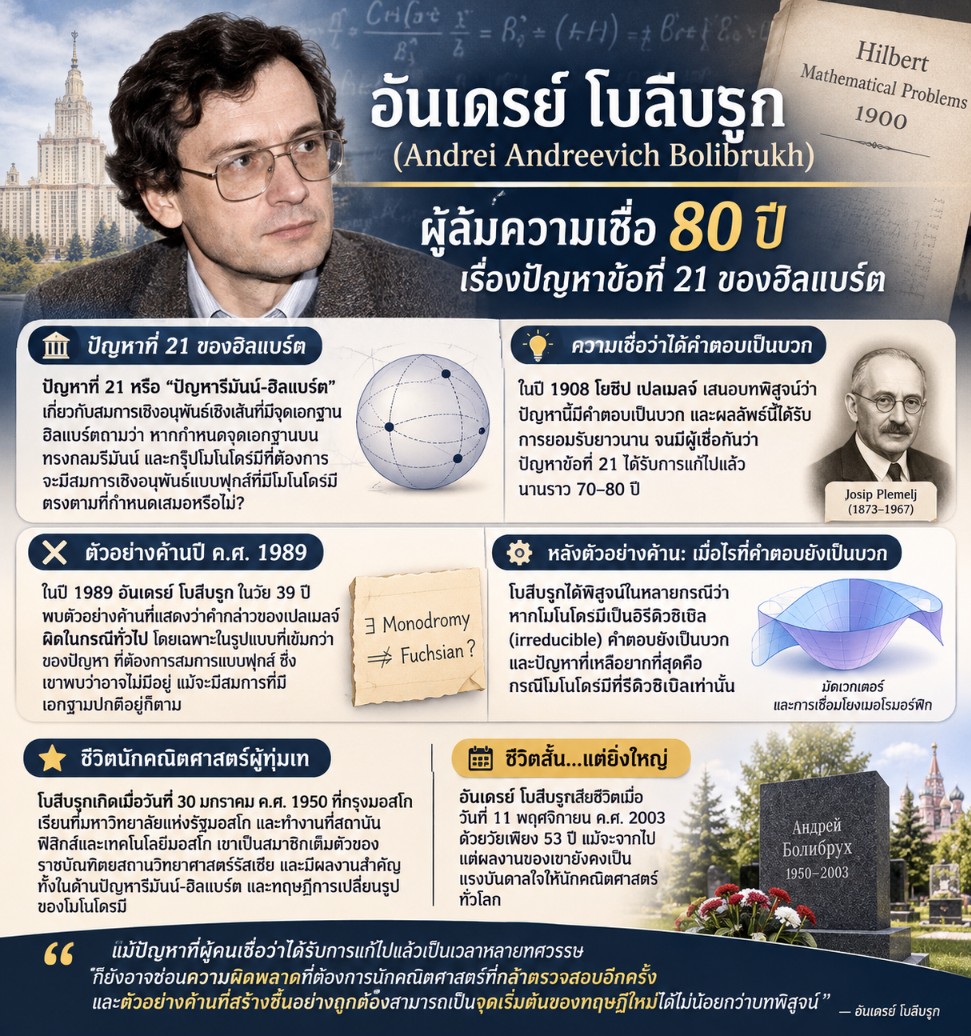
In 1900, David Hilbert proposed a list of 23 problems for mathematicians of the new century. One of these problems, long believed to have been solved with a positive answer, was overturned by a counterexample from a 39-year-old Russian mathematician in 1989. He was Andrei Andreevich Bolibrukh, born on January 30, 1950, in Moscow, and died on November 11, 2003, at the age of only 53 (Wikipedia and Wikidata state that he died in Paris, while MacTutor states Moscow). He was buried at Troyekurovskoye Cemetery in Moscow.
Hilbert's 21st problem
Problem number 21, also known as the Riemann–Hilbert problem, concerns linear differential equations with singular points. When we follow the solution of a linear differential equation around a singular point completely, the solution changes into a linear combination of the original solutions. The linear transformation that occurs is called monodromy, and the monodromy around all singular points together forms the monodromy group.
Hilbert posed the inverse question: if the singular points are specified on a Riemann sphere and the desired monodromy group is given, is there always a linear differential equation of the so-called Fuchsian class, which has singular points at those positions and monodromy matching the specified one? Hilbert wrote that Riemann himself probably had this question in mind as well.
The belief that the answer is positive
In 1908, Josip Plemelj, a Slovenian mathematician, proposed a proof that this problem has a positive solution, and this result was accepted for a long time, until one source indicated that mathematicians considered for about 70 to 80 years that the 21st problem had already been solved.
Other resulting outcomes include a weaker form of resolution. In 1957, Helmut Röhrl used the language of vector bundles to analyze complex problems in one-dimensional complex spaces, and in 1970, Pierre Deligne proved the Riemann–Hilbert theorem for algebraic connections with regular singularities, confirming the stability of the form without requiring the system to be specifically Fuchsian.
Example opposing the year 1989
In 1989, Bolibruk, who was then 39 years old and had a career that seemed like that of an ordinary mathematician, created a counterexample that astonished the field (the article states that he found it in 1988 and published it in 1989). This counterexample showed that a stronger statement of Plemelj was incorrect in the general case.
The important detail is that there are two slightly different forms of the problem. The first form asks for an equation with regular singular points, which has positive solutions. The second, stricter form asks for a Fuchsian system, which has only first-order poles at the singular points. Bolibrukh showed that, for some configurations of singular points and monodromy, there exist equations with regular singular points meeting the conditions, but no Fuchsian system can be constructed. His examples had monodromy that was reducible in low dimensions, and later he produced new counterexamples with different characteristics, including in four dimensions. Biographers describe this as a discovery that “greatly” changed his career that year.
After the sample objection: When the answer is still positive
The example, while it does not close the matter, opens a new branch of research. Bolibrukh used modern complex analytic geometry methods, particularly holomorphic vector bundles and meromorphic connections, to study under what conditions the problem has positive solutions. The famous result is that when the monodromy is irreducible, the solutions are still positive, which Bolibrukh proved in several dimensions, such as the three-dimensional case. Vladimir Kostov also obtained similar results independently. Therefore, all the difficulty comes only from the reducible monodromy.
Another area he developed is the problem of the Birkhoff standard form for systems with irregular singular points, where he demonstrated the conditions under which a system can be transformed into this form. All of this work is connected with the theory of isomonodromic deformations, which is related to the Painlevé equations and Schlesinger systems.
Work life
Bolyubruk studied at the Faculty of Mechanics and Mathematics at Moscow State University, with Mikhail Postnikov and Aleksei Chernavsky as his professors. He began working at the Moscow Institute of Physics and Technology (MIPT), and MacTutor reports that, strangely, he defended his thesis at Moscow University two years after completing the actual research, receiving the Candidate degree, later becoming a Doctor of Science, working at the Steklov Institute of Mathematics and Moscow State University, and became a full member (academician) of the Russian Academy of Sciences.
In 1994, he was invited to give a lecture at the International Congress of Mathematicians in Zurich on the topic of the Riemann–Hilbert problem and Fuchsian differential equations on Riemann spheres. He taught courses on the analytical theory of differential equations, vector bundles, and the Riemann–Hilbert problem. In the later part of his career, he was a visiting professor in Strasbourg, France. Colleagues said that he devoted equal energy to research work and to work necessary for the mathematical community. He had a wife named Nina and two children: a son, Andrey, and a daughter, Ekaterina.
Inheritance
Andrei Bolibrukh passed away on November 11, 2003, while his colleagues were writing an unfinished article with him. That work was published with a dedication to him as a “deceased colleague and co-author, and a wonderful friend.” His story serves as a reminder that even problems believed to have been solved for decades may still hide errors that require a mathematician brave enough to re-examine them, and a correctly constructed counterexample can be the starting point of a new theory just as much as a proof.