Peter Swinnerton-Dyer: The proposer of the million-dollar problem that remains unsolved
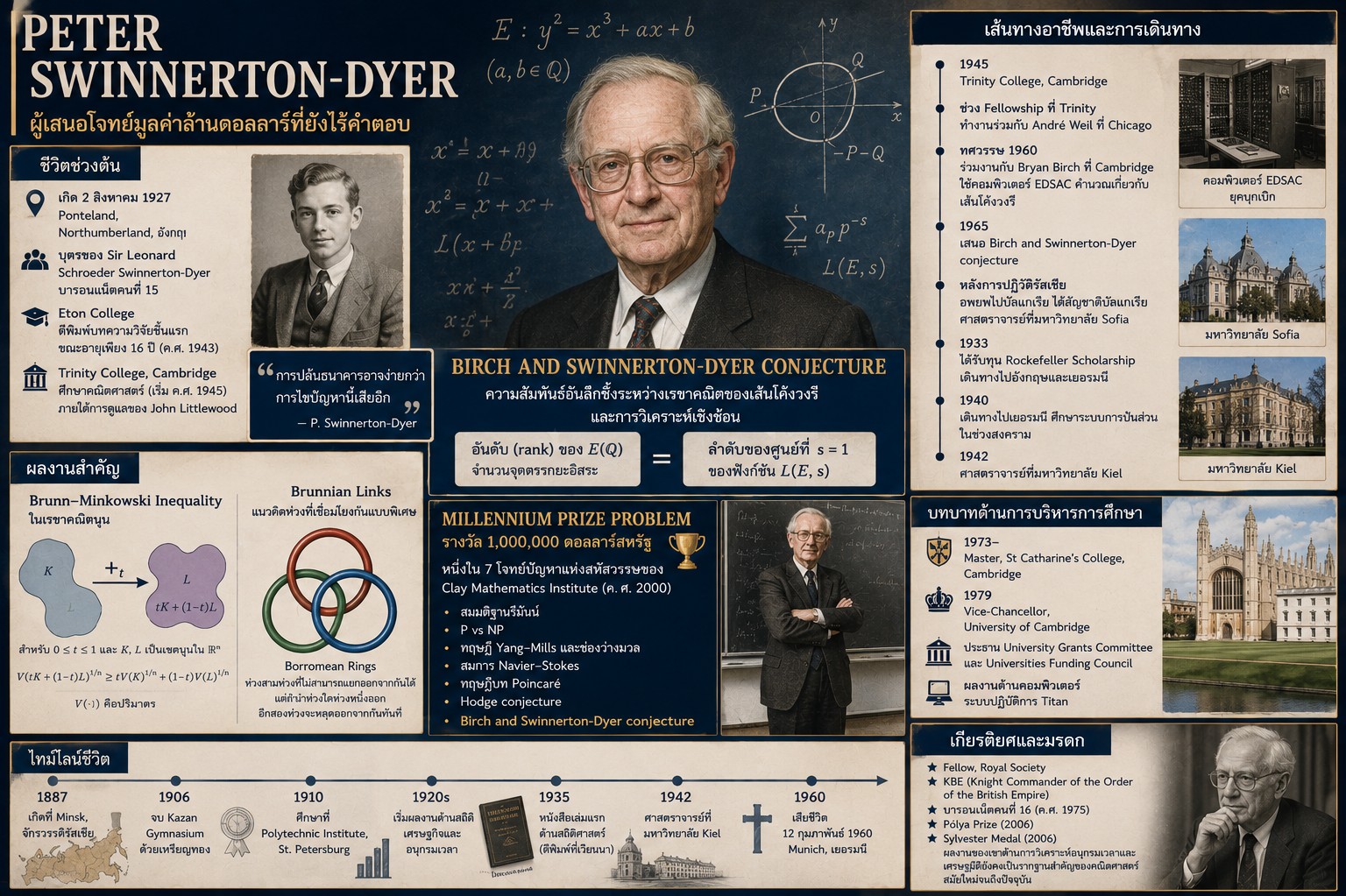
Sir Peter Swinnerton-Dyer was an English mathematician specializing in number theory at the University of Cambridge, known for the Birch and Swinnerton-Dyer conjecture proposed together with Bryan Birch, which is one of the Millennium Prize Problems of the Clay Institute, offering a prize of one million US dollars to anyone who solves it. Even though more than half a century has passed, this problem has still not been solved to this day.
A young baronet who published his works since the age of 16
Henry Peter Francis Swinnerton-Dyer was born on August 2, 1927, in the town of Ponteland, Northumberland, England. He was the son of Sir Leonard Schroeder Swinnerton-Dyer, the 15th Baronet, an engineer and businessman, and Barbara Winifred Brackenbury. The Swinnerton-Dyer family has a long history dating back to the establishment of the baronetcy in 1678.
Swinnerton-Dyer demonstrated an astonishing mathematical talent from a young age, publishing his first research paper in 1943 at the age of just 16 while still studying at Eton College. He went on to study at Trinity College, University of Cambridge in 1945 under the supervision of John Littlewood, a renowned mathematician, whom he later described as “one of the greatest mathematicians of the 20th century in the truly old-fashioned sense.” After a research fellowship period at Trinity, he spent a pivotal year in Chicago as a Commonwealth Fund Fellow, where he was “kidnapped” by another great mathematician, André Weil, to collaborate, according to his own words.
Collaboration with Bryan Birch in the pioneering computer era
The collaboration with Bryan Birch during the pioneering computer era marked the most significant turning point in Swinnerton-Dyer's career. This occurred in the 1960s when he worked with Bryan Birch at the Mathematical Laboratory of the University of Cambridge, using the EDSAC computer, one of the world's first electronic computers, to perform empirical calculations on elliptic curves. Both observed interesting patterns in the calculated data, which led to the proposal of a hypothesis published in 1965.
The Birch and Swinnerton-Dyer conjecture proposes a deep relationship between the rank of an elliptic curve, which is the value that indicates the number of independent rational solutions of the curve, and the order of zero of the associated L-function at the point s equals 1. This conjecture beautifully connects algebraic geometry with complex analysis and has become one of the fundamental pillars of modern number theory known as arithmetic geometry.
The unsolved problem of the millennium
In the year 2000, the Clay Mathematics Institute announced the Birch and Swinnerton-Dyer conjecture as one of the seven Millennium Prize Problems, which also include the Riemann hypothesis and the P versus NP problem. Anyone who can rigorously prove or disprove this conjecture will receive a reward of one million U.S. dollars.
Although there has been some progress in the direction of this conjecture, particularly the work of Andrew Wiles in proving Fermat's Last Theorem, which has foundations connected to the discoveries of Birch and Swinnerton-Dyer, the general case of this conjecture remains open and full of mysteries. Swinnerton-Dyer himself once jokingly said that robbing a bank might be easier than solving this problem, and he expected that this problem would remain unsolved during his lifetime, which turned out to be true as he had anticipated.
Influential university administrator
In addition to his research in mathematics, Swinnerton-Dyer also played a very important role in the administration of higher education in England. He held the position of Master of St Catharine’s College, Cambridge from 1973 and served as Vice-Chancellor of the University of Cambridge in 1979. Moreover, he also held the position of Chairman of the University Grants Committee and Chief Executive of the Universities Funding Council, which were key roles in shaping the higher education policy of the United Kingdom during critical periods. He also made contributions to computer science through his work on the Titan operating system.
Honor and legacy that continue to challenge the field of mathematics
Swinnerton-Dyer was elected a Fellow of the Royal Society and was awarded the KBE (Knight Commander of the Order of the British Empire), as well as inheriting the title of 16th Baronet of the family in 1975. In addition, he received the Pólya Prize and the Sylvester Medal in 2006, which are major awards of the London Mathematical Society and the Royal Society, respectively.
Peter Swinnerton-Dyer passed away on December 26, 2018, at the age of 91, leaving behind a significant academic legacy through the conjecture that bears his name and his important role in the administration of higher education in England. The Birch and Swinnerton-Dyer conjecture remains one of the most challenging and mysterious mathematical problems still awaiting to be solved. It serves as a reminder that even in an era of the most powerful computers, there are still some mathematical puzzles that remain beyond human understanding.