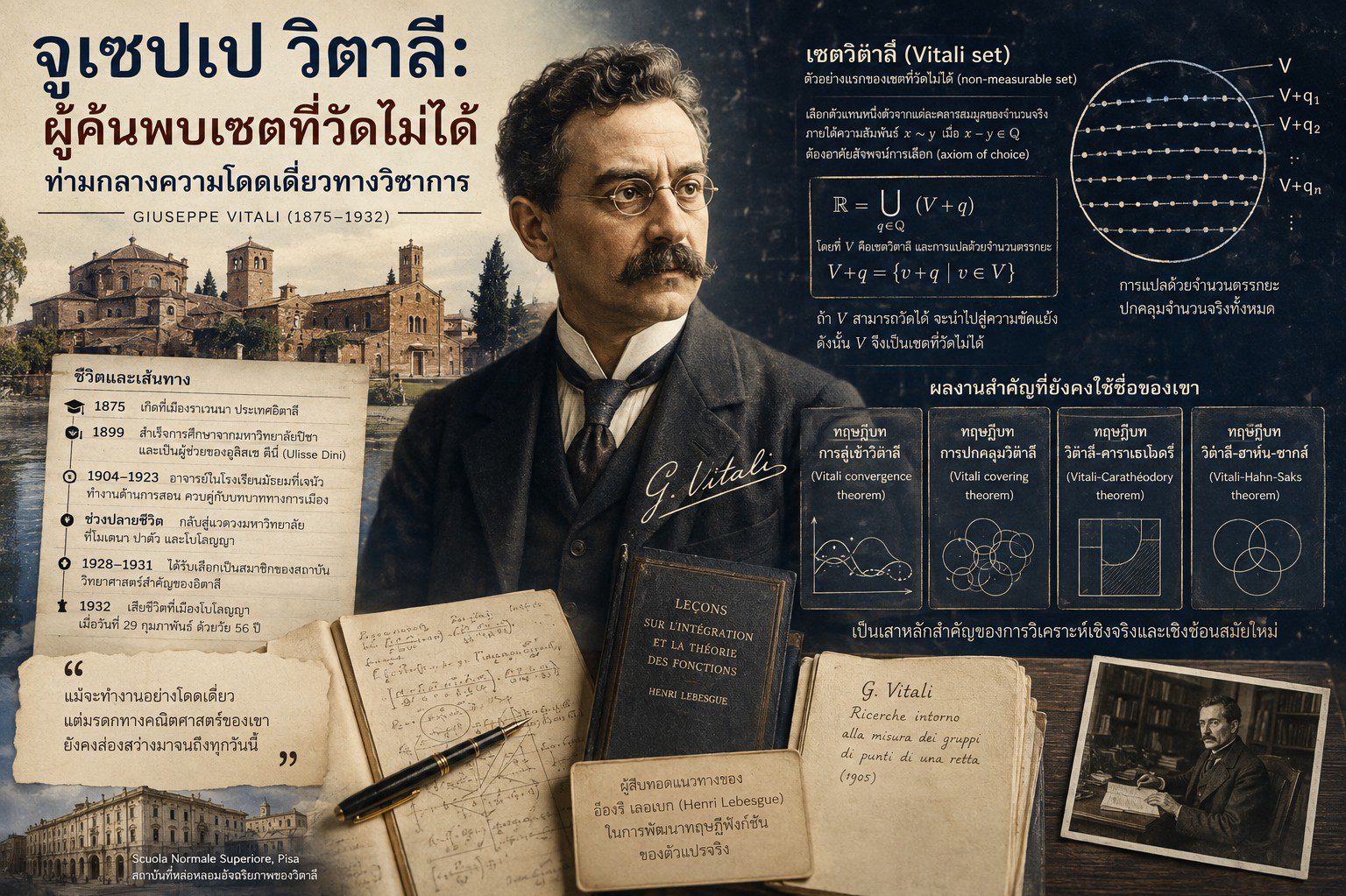
Giuseppe Vitali: The discoverer of non-measurable sets amidst academic isolation
Giuseppe Vitali: The Discoverer of Sets Giuseppe Vitali was born on August 26, 1875, in Ravenna, Italy. He was the eldest of five siblings. His father, Domenico Vitali, worked for the railway company in Ravenna, while his mother, Zenobia Casadio, took care of the house and children. Even during middle school, Vitali's academic performance was average, but when he attended high school at Dante Alighieri School, his mathematics teacher, Giuseppe Nannini, quickly recognized Vitali's outstanding talent and even wrote a letter to Vitali's father requesting permission for his son to seriously pursue the study of mathematics amid academic isolation.
From Pisa to Academic Solitude
Vitaly received a scholarship to study at the Scuola Normale Superiore in Pisa and graduated from the University of Pisa in 1899. After graduation, he became an assistant to Ulisse Dini, one of the most influential mathematicians in Italy at that time, whose guidance and endorsement were considered a solid path to a successful career. However, due to financial reasons, Vitaly had to give up this desirable position after only two years and turned to teaching in several high schools before settling at the Liceo Cristoforo Colombo in Genoa from 1904 to 1923.
Although living in the city of Genoa, which was not completely cut off from intellectual life, Vitale worked mostly in academic isolation throughout the middle of his career. He also had a political role as a member of the municipal council affiliated with the Socialist Party and as a judge of the municipal court.
A set that challenges mathematical intuition
Vitaly's most famous work is the creation of the Vitali set in 1905, which was the first example of a non-measurable subset of real numbers. This discovery was a significant step in measure theory because it showed that not all sets of real numbers can have a "length" or "measure" assigned in a way that is consistent with the fundamental axioms of Lebesgue measure.
Vitaly constructed this set using the axiom of choice to select one representative from each equivalence class of real numbers under the relation that two numbers are equivalent if their difference is a rational number. This discovery caused great astonishment in the mathematical community at the time because it contradicted the basic intuition that every set should be measurable, and it became a classic example taught in measure theory courses around the world up to the present day. It demonstrates the necessity of restricting the domain of a measure function to only the class of 'measurable' sets.
Other works that paved the way for modern measurement theory
Apart from the Vitali set, he also has many other significant works that still bear his name in modern analytical mathematics textbooks. The Vitali convergence theorem is an important condition used to determine when a sequence of pointwise convergent functions converges in the sense of an integral. The Vitali covering theorem is an important fundamental tool used in real analysis and measure theory, which plays a key role in proving the Lebesgue differentiation theorem.
In addition, he also collaborated with other mathematicians to create additional significant works, such as the Vitali-Carathéodory theorem, with Constantin Carathéodory, and the Vitali-Hahn-Saks theorem, with Hans Hahn and Stanisław Saks. These works are all major pillars of modern real and complex analysis. Vitali is also recognized as one of the most important pioneers who carried on Henri Lebesgue's approach in developing the theory of functions of a real variable.
Returning to the academic circle in the final stage of life
Towards the end of his career, Vitali returned to the academic sphere, teaching at the University of Modena, the University of Padua, and finally at the University of Bologna. His work was officially recognized in the later years of his life when he was elected a member of the Turin Academy of Sciences in 1928, the Accademia Nazionale dei Lincei in 1930, and the Bologna Academy of Sciences in 1931.
Giuseppe Vitali passed away on February 29, 1932, in Bologna at the age of 56. Although most of his working life was spent in academic solitude relatively far from the main centers of mathematics in Europe, his work is recognized as being one of the most important pioneers of the theory of real-variable functions and modern measure theory. Vitali sets and theorems bearing his name remain fundamental tools that mathematicians around the world study and use to this day, nearly a century after his passing.