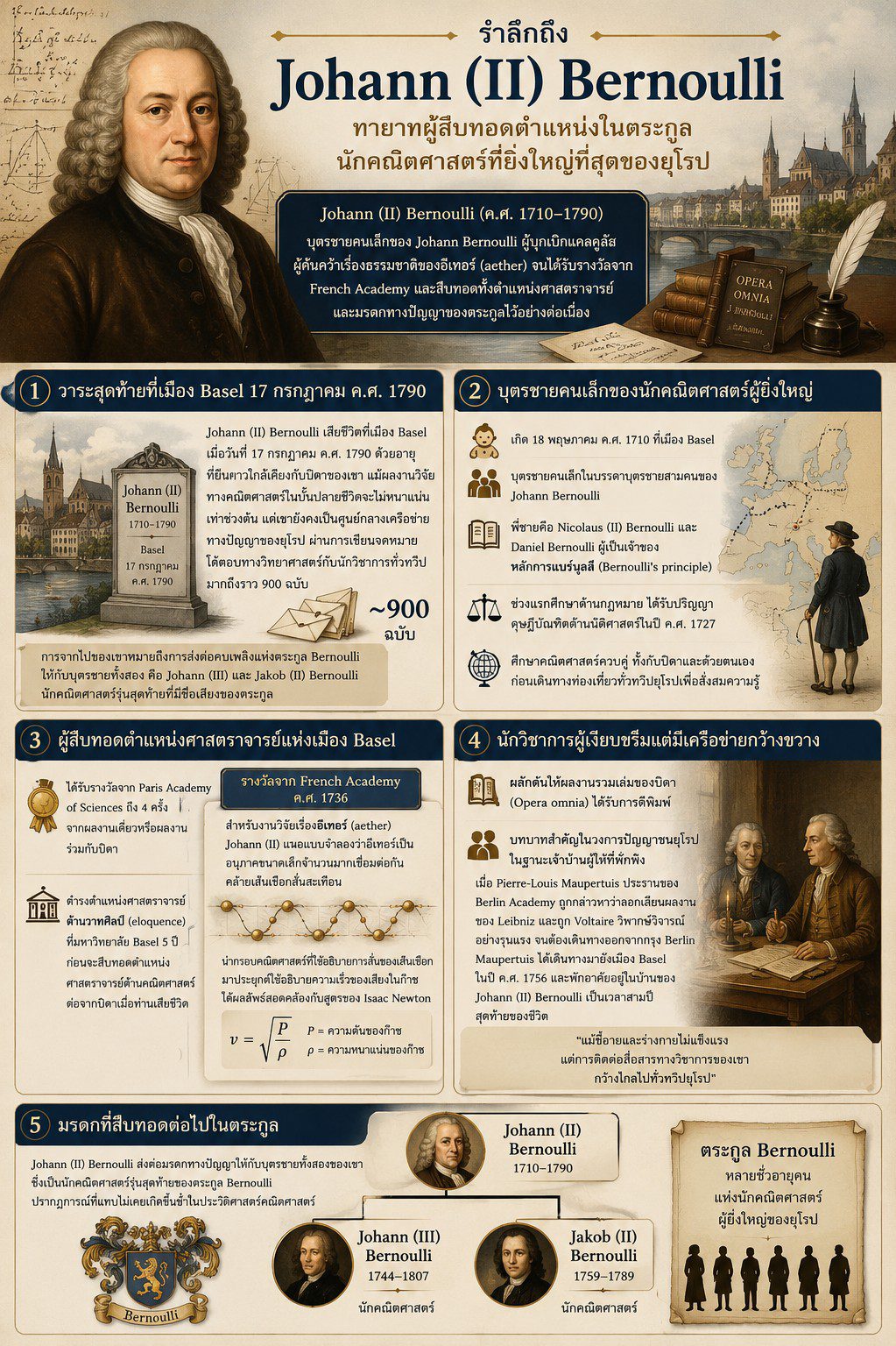
Remembering Johann (II) Bernoulli, the Heir Who Continued the Legacy of Europe’s Greatest Mathematical Dynasty
Johann (II) Bernoulli was the youngest son of Johann Bernoulli, the pioneer of calculus, and a mathematician who studied the nature of the aether, for which he received a prize from the French Academy. He continued the family’s intellectual legacy by inheriting both his father’s professorship and the mathematical traditions of the Bernoulli dynasty. On this occasion, we look back on his life and contributions.
His Final Days in Basel: July 17, 1790
Johann (II) Bernoulli died in Basel on July 17, 1790, at an age nearly as long as that of his father. His death marked the end of the life of a scholar whose mathematical research became less prolific in his later years compared with his early career, but who continued to serve as a central figure in Europe’s intellectual network until his final days. Through his scientific correspondence with scholars across the continent, he maintained an extensive exchange of ideas, leaving behind around 900 letters that reflected his enduring influence within the European academic community.
His passing also marked the passing of the torch of the Bernoulli family legacy to his two sons, Johann (III) Bernoulli and Jakob (II) Bernoulli, who became the final generation of the family’s renowned mathematicians to achieve significant prominence.
The Youngest Son of a Great Mathematician
Johann (II) Bernoulli was born on May 18, 1710, in Basel. He was the youngest of the three sons of Johann Bernoulli, the mathematician who pioneered calculus alongside Gottfried Leibniz. He was also the younger brother of Nicolaus (II) Bernoulli and Daniel Bernoulli, the renowned physicist known for Bernoulli’s principle.
Although he was born into a family renowned for mathematics, Johann (II) initially chose to pursue law, earning a doctoral degree in law in 1727. However, he continued studying mathematics alongside his legal work, both through collaboration with his father and through his own research. He later traveled throughout continental Europe to broaden his knowledge and intellectual experience.
The Successor to the Professorship in Basel
What made Johann (II) Bernoulli particularly memorable was his outstanding success in academic competitions. He received prizes from the Paris Academy of Sciences four times, both for his individual works and for collaborations with his father. These achievements qualified him to become professor of mathematics at the University of Basel, succeeding his father after Johann Bernoulli the elder passed away. Before that, he had served as a professor of eloquence at the same university for five years.
In 1736, he received a prize from the French Academy for his research on the aether, a hypothetical medium that scientists of the time believed allowed light to travel through space. In this work, Johann (II) proposed a model in which the aether was composed of countless tiny particles connected like vibrating strings. He applied the mathematical framework used to describe the vibrations of strings to explain the speed of sound in gases, producing results consistent with the formula previously calculated by Isaac Newton.
The Reserved Scholar with a Wide Intellectual Network
Although Johann (II)’s shy personality and relatively fragile health did not hinder his academic communication, he played an important role in promoting the publication of his father’s collected works (Opera omnia). He also held a significant position in Europe’s intellectual community as a host who offered shelter and support to fellow scholars. When Pierre-Louis Maupertuis, the president of the Berlin Academy, was accused of plagiarism involving the works of Leibniz and was harshly criticized by Voltaire, forcing him to leave Berlin, Maupertuis traveled to Basel in 1756. There, he stayed at the home of Johann (II) Bernoulli for the final three years of his life.
The Legacy Continued Through the Family
On the anniversary of his passing each year, the name of Johann (II) Bernoulli remains a powerful reflection of the remarkable Bernoulli dynasty—a family that did not produce only a single great thinker, but successfully passed on its intellectual legacy through generations. Through his two sons, who became the final generation of the Bernoulli family’s mathematicians to achieve notable recognition, the family’s tradition of mathematical excellence continued for decades. Such a sustained inheritance of mathematical talent and influence across multiple generations remains a phenomenon rarely seen in the history of mathematics.