Remembering Florence Nightingale David, the woman who opened the door of statistics for women
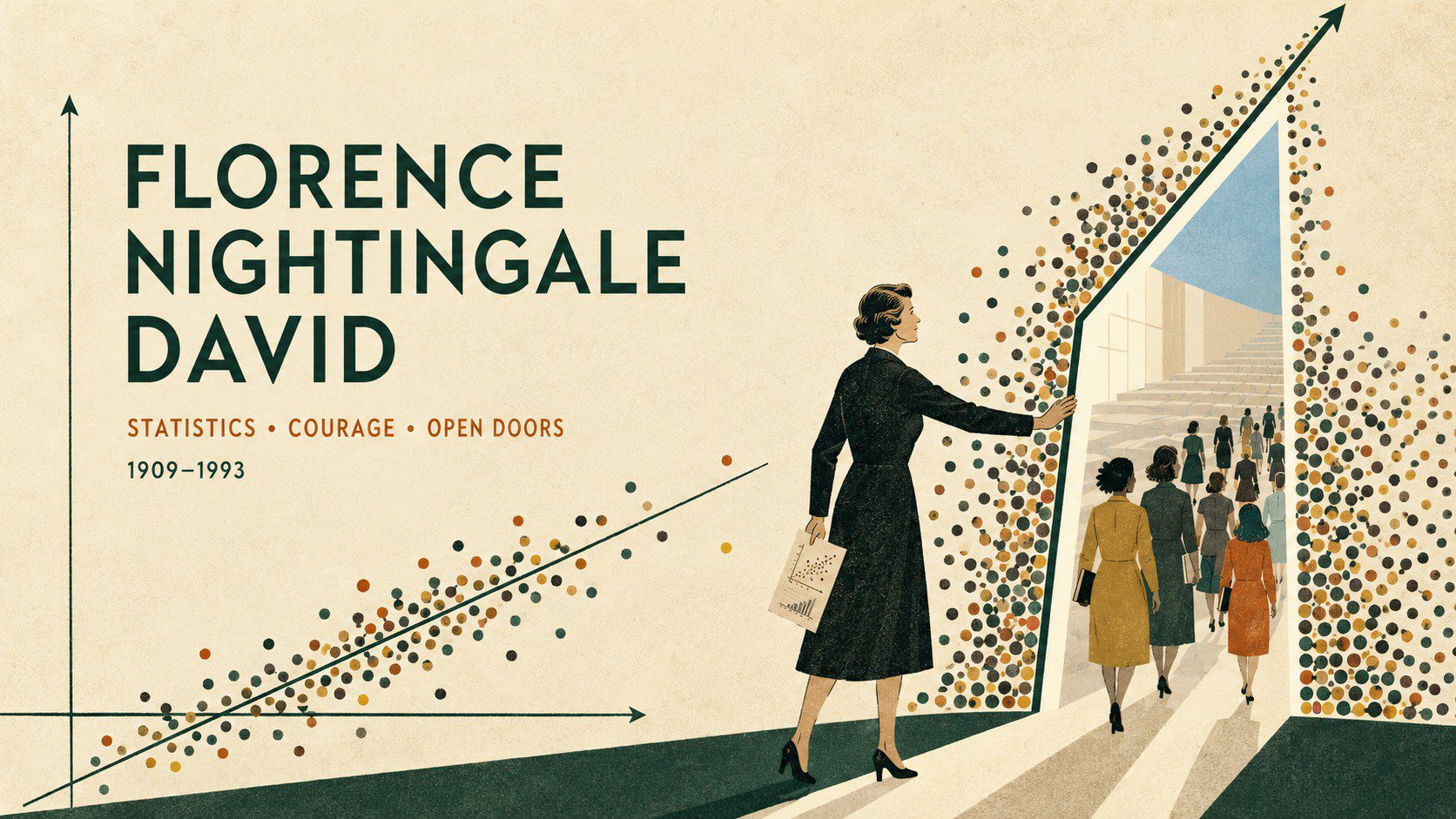
Florence Nightingale David was a British female statistician who pioneered the calculation of the distribution of correlation coefficients, which is a key foundation of modern statistics, and she was one of the women who played a major role in opening opportunities for other women to enter the field of statistics. On this occasion, we want to look back and remember the life of a thinker who never gave up in the face of gender obstacles in her time.
Final agenda in Kensington on July 23, 1993
Florence Nightingale David passed away from lung cancer on July 23, 1993, at her home in Kensington, Contra Costa County, California, at the age of 83. Just a year before, in August 1992, she had received the Elizabeth L. Scott Award as the first recipient. This award recognized her efforts to open doors for women in the field of statistics, as well as her decades-long contributions to research in combinatorial mathematics, statistical methods, and the history of the discipline.
Even though he achieved great success throughout his career, David never considered himself a very influential person. When asked late in life whether he felt he had an influence on the field, he humbly replied that maybe a little, but he didn't see his life's role as creating influence.
A dream denied because I’m a woman
Florence Nightingale David was born on August 23, 1909, in the village of Ivington near Leominster, England, into a family where both her parents were elementary school principals. She was named “Florence Nightingale” because her parents were friends with the famous nurse Florence Nightingale, who passed away the year after she was born.
As a child, she received private lessons from the local priest starting at the age of five. When she officially started school at 10, she focused mainly on math, aiming to become an actuary. She went on to study at Bedford College for Women in 1929 and graduated with a degree in mathematics in 1931. However, when she applied for a job at an insurance company, she was rejected just for being a woman, as at that time insurance companies only hired male actuaries.
Karl Pearson's student
With unwavering determination, David reached out to work with Karl Pearson, the great statistician at University College London, and became his research assistant while also pursuing a PhD. While working there, she also served as an assistant lecturer in the statistics department and worked closely with Jerzy Neyman and Karl Pearson's son, Egon Pearson. Together, the three of them even started a new academic journal called Statistical Research Memoirs.
After Karl Pearson passed away, Neyman supported her in completing her PhD, which she finished in 1938. Her thesis focused on calculating the distribution of the correlation coefficient in detail, which required solving very complex multiple integrals. This work became an essential tool that statisticians worldwide still reference today, as the correlation coefficient is one of the most widely used statistical tools for analyzing the relationship between two variables.
The war period and practical work
During World War II, David took advantage of the greater opportunities available to women at the time, working as a trial officer for the Ministry of Supply's Ordinance Board and as a senior statistician in the research and experimental department, applying her statistical knowledge to solve real problems in urgent national situations.
During World War II, David took advantage of the expanded opportunities for women at the time by working as a test officer for the Ministry of Supply's Ordinance Board and as a senior statistician in the Research and Experimental Department. After the war, she returned to work as a lecturer and researcher at University College London, eventually becoming a professor in 1962. Between 1958 and 1967, she was also a visiting professor at the University of California, Berkeley. Later, she succeeded Jerzy Neyman as the head of the statistics department. In 1967, she permanently moved to the United States and joined the Department of Biostatistics at the University of California, Riverside, before becoming the head of the statistics department in 1970 until her retirement in 1977, applying her statistical knowledge to solve real problems in emergency situations in the country.
A legacy that opens doors for the next generation of women
David has a wide range of research work, covering combinatorial mathematics, statistical methods, and the history of probability and statistical concepts. She is also known for her lifelong efforts to create opportunities for women in the field of statistics, which was a male-dominated field in her time.
In 2001, the university where she used to work established the Florence Nightingale David Award to honor female statisticians who serve as role models for other women in the field, whether through research, leadership, statistical education, or professional service. Every year on the anniversary of her passing, Florence Nightingale David's name continues to inspire generations of female statisticians, showing that dedication and academic excellence can overcome the toughest gender barriers of their time.