Richard V. Kadison: The one who carried the operator theory field all by himself in the 1950s
There are only a few mathematicians who have been praised as carrying an entire academic field almost single-handedly at one point in history. Richard V. Kadison was one of them. He was an American mathematician who was a pillar of operator algebra theory in the 1950s and pioneered a problem later known as the Kadison–Singer problem, which puzzled the mathematics community for decades before being solved in 2013.
A young gymnast from New York City
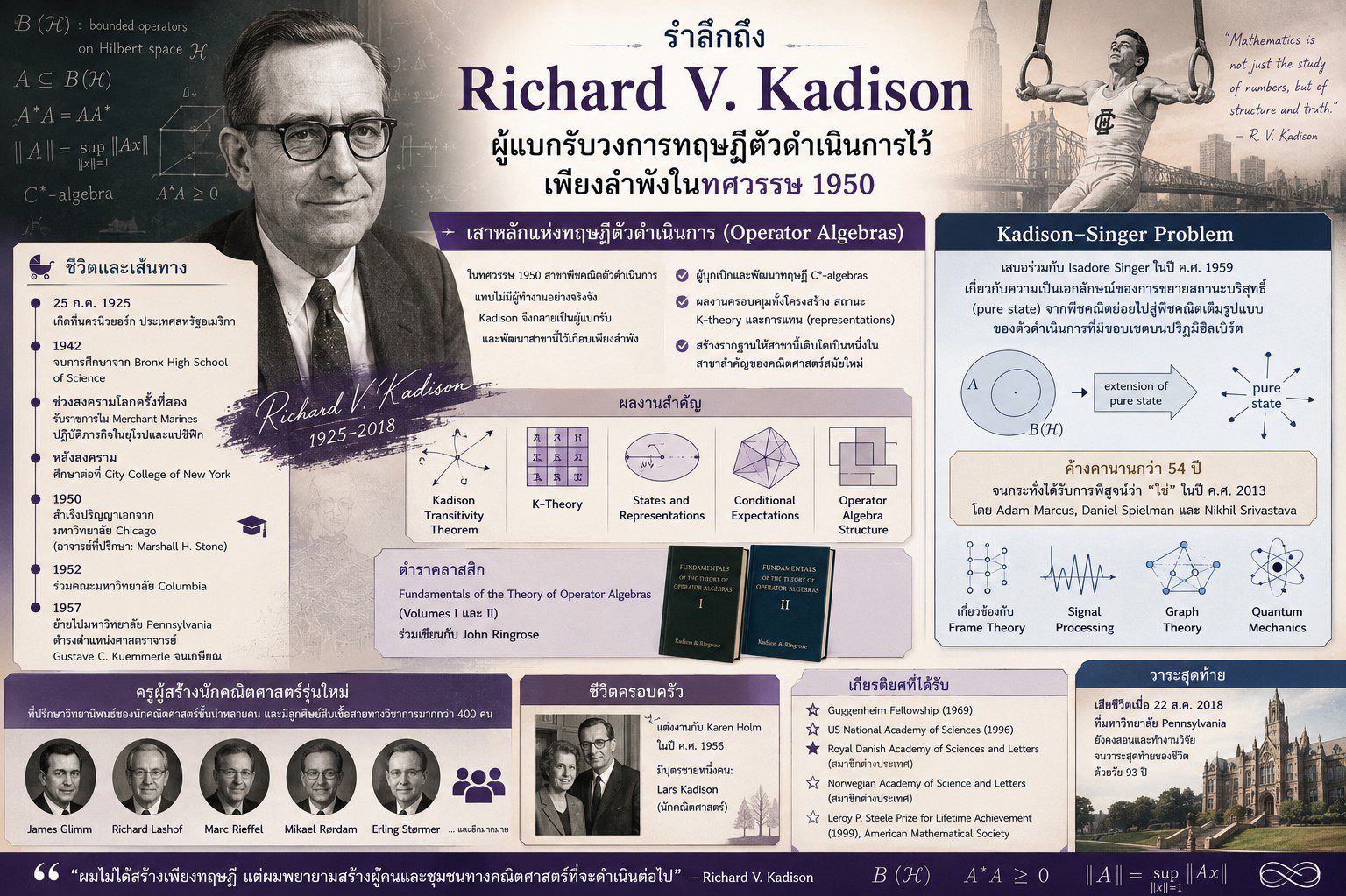
Richard Vincent Kadison was born on July 25, 1925, in New York City, USA. His father, David Edward Kadison, was the son of Jewish immigrants who had changed their last name from Kadushin to Kadison before getting married. His mother, Rae Siegel, was born in Russia and immigrated to the U.S. in 1902. Kadison went to Bronx High School of Science, a famous science high school in New York, and graduated in 1942 before continuing his studies at City College of New York.
Apart from his math skills, Kadison was also a top-level gymnast. He had special expertise in flying rings, reaching Olympic-level standards. During World War II, he served as an officer in the Merchant Marines, carrying out missions in both Europe and the Pacific. After the war ended, he went on to graduate school at the University of Chicago and earned his PhD in 1950 under the supervision of the famous mathematician Marshall H. Stone.
The one carrying the algebra operator scene almost alone
In 1952, Kadison joined the faculty at Columbia University and started what later mathematicians described as 'carrying the operator algebra field almost single-handedly.' Throughout the 1950s, this field had its roots in the research of John von Neumann and Francis Murray in the 1930s, which connected linear operator theory on Hilbert spaces with quantum mechanics. But in the postwar period, when many areas of mathematics received less attention, Kadison was one of the few mathematicians who continued to seriously dedicate themselves to research in this field.
In 1957, he moved to teach at the University of Pennsylvania as the Gustave C. Kuemmerle Professor, a position he held for the rest of his career. His vision and dedication made Penn's mathematics department a major center for operator algebra in the world. He also supervised the theses of many famous PhD students, including James Glimm, Richard Lashof, Marc Rieffel, Mikael Rørdam, and Erling Størmer. To this day, he has over 400 'academic descendants' through the lineage of his thesis students.
From Kadison Transitivity Theorem to K-Theory
Kadison's research covers almost every aspect of operator algebra theory. One of his key contributions is the Kadison transitivity theorem, which is a fundamental tool for studying the structure of C*-algebras. He also made important contributions to the K-theory of operator algebras, which is a field that studies algebraic structures related to vector spaces and modules in the context of operator algebras.
The two classic textbooks he co-wrote with John Ringrose on the Fundamentals of the Theory of Operator Algebras are still standard reference books that later generations of mathematicians use to study this field today.
Kadison–Singer Problem: A Puzzle Left Hanging for Six Decades
The work that made Kadison's name known far beyond the operator algebra field is the Kadison–Singer problem, which he proposed together with Isadore Singer in 1959. This problem deals with the uniqueness of extending pure states from a subalgebra to the full operator algebra on a Hilbert space, and it has roots connected to Paul Dirac's work in quantum mechanics.
This problem became one of the most challenging issues in the field of mathematics because it has deep connections with many other areas, including frame theory, signal processing, and graph theory. It wasn’t until 2013 that mathematicians Adam Marcus, Daniel Spielman, and Nikhil Srivastava managed to solve it, showing that the answer is 'yes,' meaning that such an expansion is indeed unique. This discovery caused quite a stir in the math community since it solved a problem that had been left unresolved for over half a century.
Honor and family life
Kadison married Karen Holm in 1956 and had one son, Lars Kadison, who later also became a mathematician like his father. Throughout his career, Kadison received many honors, including a Guggenheim Fellowship in 1969, being a member of the US National Academy of Sciences since 1996, a foreign member of the Royal Danish Academy of Sciences and Letters and the Norwegian Academy of Science and Letters, as well as the Leroy P. Steele Prize for Lifetime Achievement from the American Mathematical Society in 1999.
A legacy that keeps growing
Richard Kadison passed away on August 22, 2018, at the age of 93. He was still teaching at the University of Pennsylvania until the very end and had planned to teach in the next semester before he passed away. His life reflected a mathematician who not only produced valuable research but also dedicated himself to nurturing and supporting the next generation in the field he loved. Thanks to him, operator algebra theory grew from a field that hardly anyone paid attention to into one of the key areas of modern mathematics, still connected to quantum physics and other applied mathematics today.