Paul Turan: Pioneer of Extreme Graph Theory Amid the Darkness of War
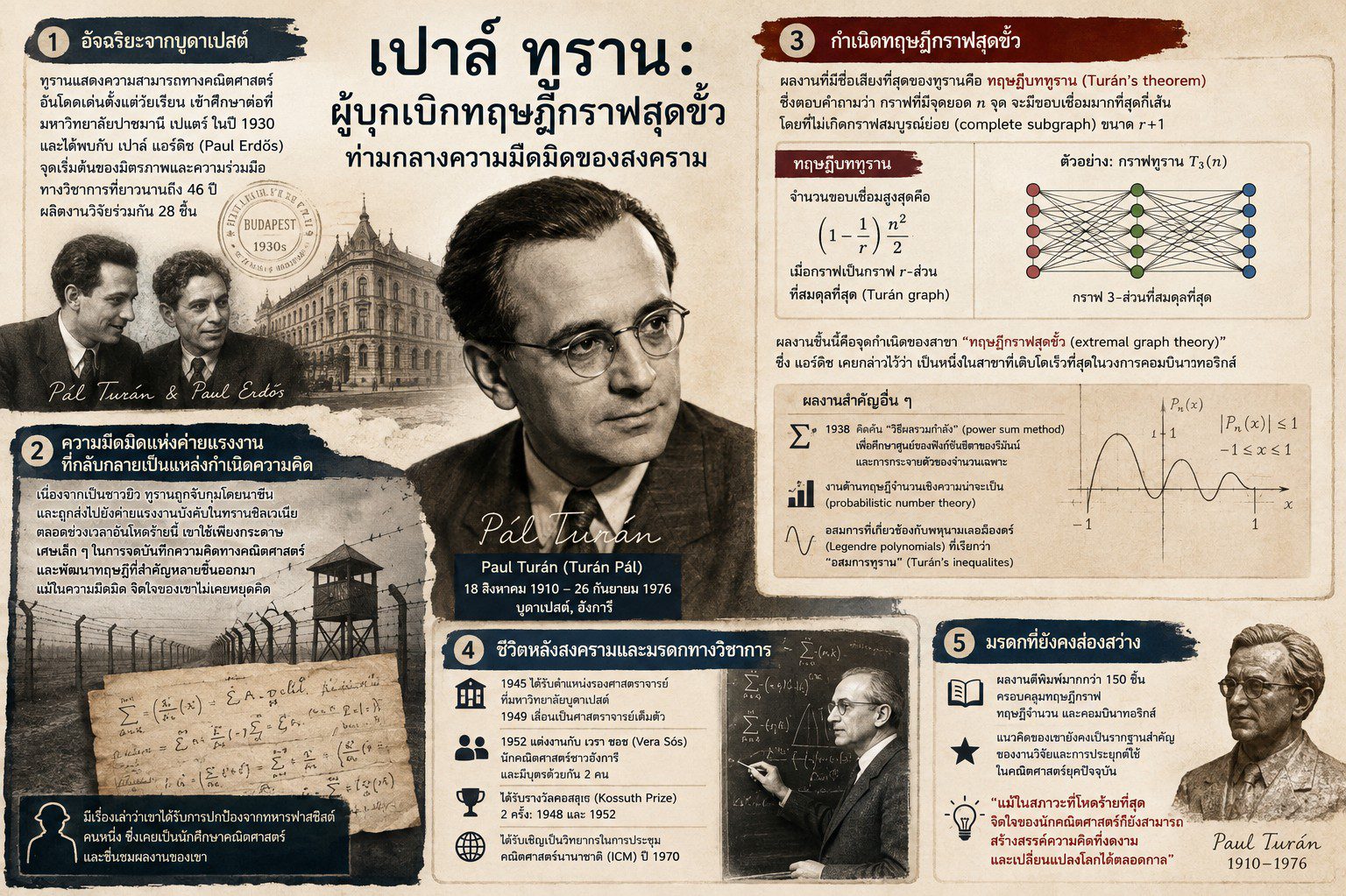
Paul Turán (Paul Turán), or in Hungarian, Pál Turán (Turán Pál), was born on August 18, 1910, in Budapest, Hungary, into a Jewish family that faced severe discrimination and anti-Semitism throughout his life. However, amid those hardships, Turán produced mathematical works that permanently transformed the fields of number theory and combinatorics.
Genius from Budapest
Turan displayed outstanding mathematical abilities since his high school years in Budapest. He enrolled at Pázmány Péter University (now Eötvös Loránd University) in September 1930, and in that same year, he met Paul Erdős, another great mathematician. They immediately discovered a shared interest in number theory, which became the beginning of a friendship and academic collaboration that lasted 46 years, producing as many as 28 joint research papers. Turan received a teaching certificate in 1933 and earned his doctorate under the supervision of Lipót Fejér in 1935.
The darkness of the labor camp that turned into a source of ideas
Being Jewish, Turán fell victim to the numerus clausus policy that limited the number of Jews in universities, which prevented him from finding a job at a university for many years. In 1940, he was arrested by the Nazis and sent to a forced labor camp in Transylvania, before being transferred to several other camps until 1944. Remarkably, during this brutal period, Turán was able to develop some of the best mathematical concepts of his life, using only small scraps of paper to record his ideas, and he published these works after the war ended. It is said that he was protected by a fascist soldier who had once been a mathematics student and admired his work.
The Origin of Extreme Graph Theory
Turán's most famous work is Turán’s theorem, which he developed during 1940-1941. This theorem answers the question of how many edges a graph with n vertices can have while still avoiding the presence of a complete subgraph of size r+1 within it. The solution to this problem is the Turán graph, which is the most balanced r-partite graph structure. This work is considered the origin of the field of extremal graph theory, which Erdős once described as one of the fastest-growing areas in combinatorics.
In addition, Turán also had many other important works, such as the invention of the 'power sum method' in 1938 to study the zeros of the Riemann zeta function and the distribution of prime numbers, as well as significant work in probabilistic number theory and inequalities related to Legendre polynomials, known as 'Turán’s inequalities'.
Life after the war and academic legacy
After the end of World War II, Turán received the position of associate professor at the University of Budapest in 1945 and was promoted to full professor in 1949. He married Vera Sós, another mathematician, in 1952 and had two children together. Turán was awarded the Kossuth Prize twice, in 1948 and 1952, and was invited as a speaker at the International Congress of Mathematicians (ICM) in 1970.
Paul Turán passed away on September 26, 1976, in Budapest due to leukemia. Over the course of his career, he produced more than 150 published works. Turán's story is a powerful reminder that even in the harshest conditions, the mind of a mathematician can still create beautiful ideas and change the academic world forever.