Remembering Blaise Pascal: The Genius Who Connected Mathematics, Philosophy, and Faith
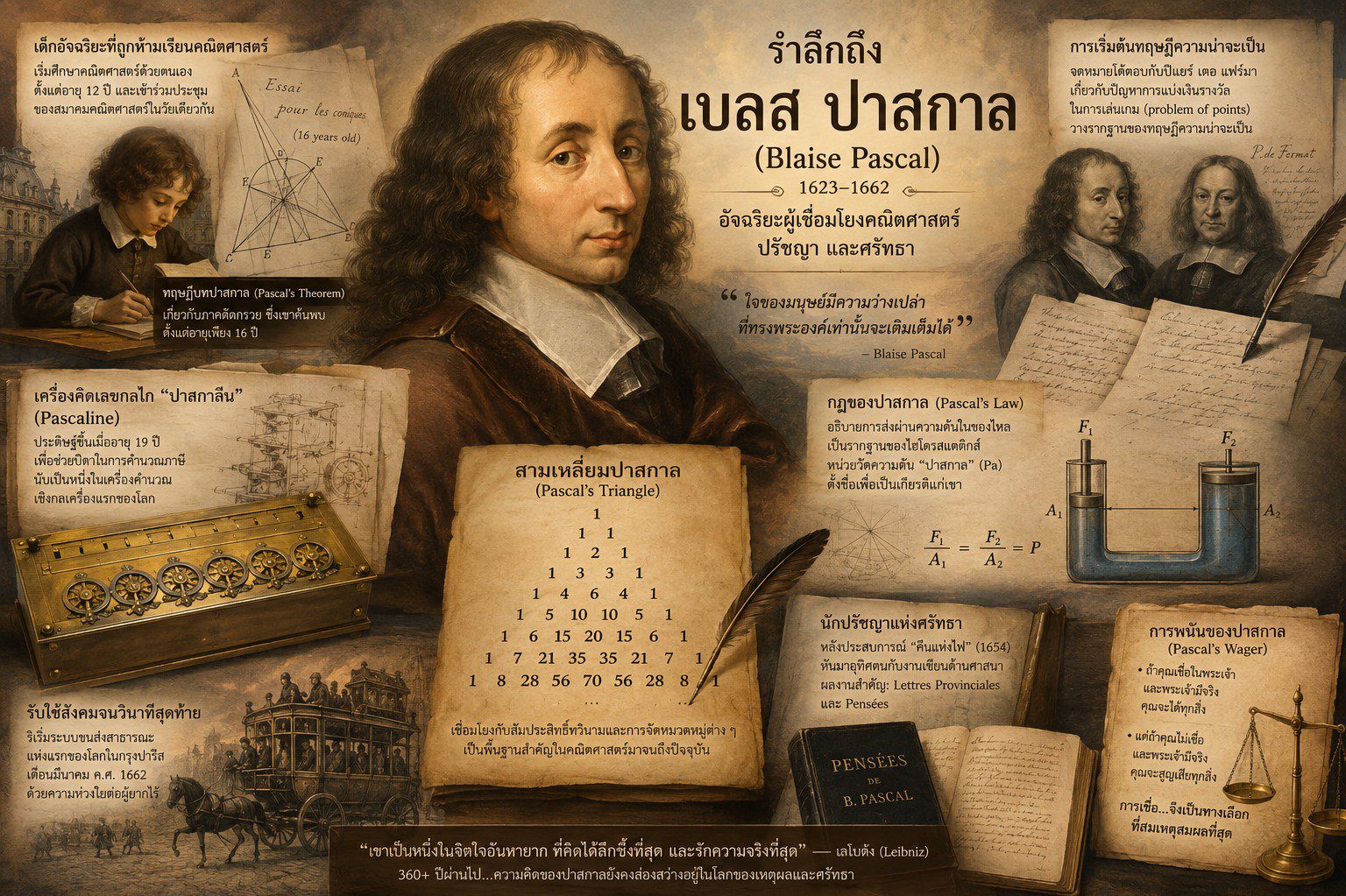
On August 19, 1662, in Paris, France, Blaise Pascal passed away at the age of only 39 from a malignant tumor in his stomach that had spread to his brain. Although he lived a short life, Pascal left an enormous intellectual legacy, covering mathematics, physics, philosophy, and theology, earning him recognition as one of the greatest geniuses in the history of human thought.
The genius child who was forbidden to study mathematics
Pascal was born in Clermont-Ferrand, France, as the third child and only son of Étienne Pascal. His mother passed away when he was only three years old. In 1631, the Pascal family moved to settle in Paris. His father, who had unusual educational ideas, decided to teach all three children himself, and surprisingly, he deliberately forbade Pascal from studying mathematics until he was 15 years old, even going so far as to remove all mathematics books from the house. However, this prohibition only sparked Pascal's curiosity. He began studying geometry on his own at the age of 12, and at the same age, he also started attending meetings of the mathematical society.
Mechanical calculator and magic triangle
One of Pascal's most remarkable works was the invention of the mechanical calculator "Pascaline" at the age of only 19, to help his father, who worked as a tax officer, calculate numbers more quickly and conveniently. This calculator is considered one of the first mechanical calculators in the world and is an important starting point that paved the way for the development of calculators and computers later on, which is a key reason why the programming language "Pascal" was named in his honor afterward.
Another work that people around the world are well aware of is Pascal’s triangle, a triangular number structure where each number is the sum of the two numbers directly above it. This triangle has deep connections with binomial coefficients and continues to be a widely used basic teaching tool in mathematics classrooms around the world to this day. Although this concept was discovered before Pascal in many cultures, Pascal was the one who systematically compiled and presented its properties.
Pioneer of probability theory together with Fermat
In 1654, Pascal entered into a famous correspondence with Pierre de Fermat, another great mathematician, to solve a problem concerning the division of stakes in a game of chance that had to be stopped prematurely (the problem of points). This exchange of ideas between the two laid an important foundation for what later became probability theory, a branch of mathematics that revolutionized human understanding of uncertainty and risk, and became a fundamental basis for modern statistics, economics, and data science.
In addition, Pascal also made significant contributions to projective geometry, particularly Pascal's theorem regarding conic sections, which he discovered at the age of only 16. He also conducted research on fluids that led to Pascal's law in hydrostatics, which explains the transmission of pressure in fluids. The unit of pressure, the 'pascal' (Pa), in the International System of Units was also named in his honor.
From Scientist to Religious Philosopher
On the night of November 23, 1654, Pascal experienced an intense religious experience known as the 'Night of Fire,' which completely changed the direction of his life. Although he never entirely abandoned his interest in science and mathematics, after that he focused most of his attention on religious writing. An important work from this period is Lettres Provinciales Satirical writing in defense of Yin-Yang ideas, and Pensées (Thought) A compilation of writings intended to systematically defend Christianity, which was published after his death, and includes the famous concept of 'Pascal’s Wager,' a decision-theory argument explaining why believing in God is the most reasonable choice.
In the later years of his life, even though he was continuously ill, Pascal continued to dedicate himself to society. He initiated the world's first public transportation system in Paris in March 1662 out of concern for the poor. Blaise Pascal died just a few months later at the home of his sister Gilberte in Paris. His intellectual legacy, which deeply connected scientific reason with religious faith, continues to inspire thinkers around the world to this day, more than 360 years after his passing.