Vladimir Roklin: A mathematician who went through a prisoner-of-war camp to the pinnacle of topology
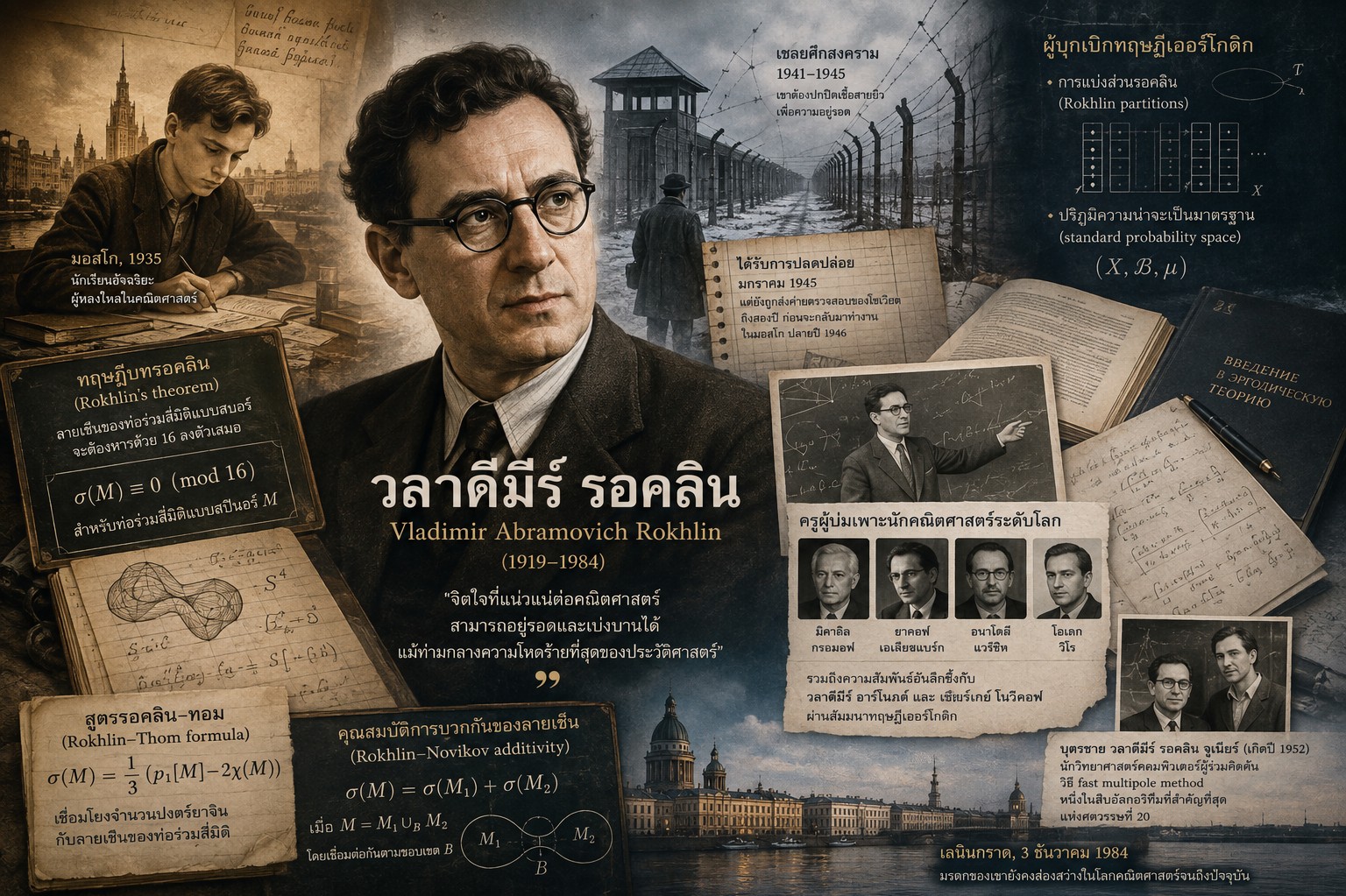
Vladimir Abramovich Rokhlin was born on August 23, 1919, in Baku, Azerbaijan, into a well-off Jewish family. His father, Abram Rokhlin, was a prominent social-democratic activist, while his mother, Henrietta Levenson, was a physician who graduated in France. However, tragedy visited the family early on when his mother died in 1923 during a period of political unrest, and later in 1941, his father was executed during Stalin's Great Purge.
From a gifted student to a prisoner of war
Roklin displayed outstanding mathematical talent from a young age. He studied calculus, analytic geometry, and advanced algebra on his own, and in August 1935, just before his 16th birthday, he was granted special permission to study at the Faculty of Mechanics and Mathematics at Moscow University under the supervision of Abraham Plessner. He graduated in 1940, and in 1941, when Nazi Germany invaded the Soviet Union, Roklin volunteered to join the Moscow People's Volunteer Corps but was captured as a prisoner of war and had to spend four years in a German POW camp. During that time, he had to conceal his Jewish heritage from the Nazis in order to survive.
After being liberated by the Soviet army in January 1945, Roklin faced hardship once again when he was sent to a Soviet inspection camp for two years under suspicion of possibly being a spy for the Germans or the Western powers. It was not until December 1946 that he was allowed to return to work in Moscow as a secretary for Pontryagin.
Pioneer of four-dimensional topology
Even though he went through many hardships, Rokhlin created significant works that transformed the face of algebraic topology. His most famous work is Rokhlin’s theorem, discovered in 1952, which shows that the signature of a spinor four-dimensional manifold must always be divisible by 16. This theorem became a key component in the development of modern topology, and the extensions to higher dimensions by Kirby and Milnor also played an important role in the theory of smooth structures.
In addition, Rokhlin also discovered the Rokhlin-Thom formula, which shows the relationship between Pontryagin numbers and the signature of four-dimensional manifolds. This formula became an important conceptual foundation that later led to Hirzebruch's multidimensional theorem. In 1966, Rokhlin, together with Sergei Novikov, discovered the 'additivity' property of the signatures of manifolds with boundaries when connected according to all components of the boundary.
Pioneer of ergodic theory and standard probability spaces
In addition to topology, Rokhlin also made significant contributions to measure theory and ergodic theory. He introduced the concept now known as “Rokhlin partitions” and the idea of a “standard probability space,” which became fundamental tools in the study of dynamical systems. His interest in ergodic theory developed even before the war, from his collaboration with Plesser and the influence of Kolmogorov, who was actively promoting these ideas at the time.
A teacher who nurtures world-class mathematicians
In 1959, Rokhlin moved to work at Leningrad University, and in 1961 he was appointed head of the Department of Geometry. Here, he became a teacher who had a profound influence on many young mathematicians. His students include Mikhail Gromov, one of the greatest geometers of the era, Yakov Eliashberg, Anatoly Vershik, and Oleg Viro, all of whom later made a name for themselves in their respective fields. Rokhlin also influenced Vladimir Arnold and Sergey Novikov through the ergodic theory seminars he organized at Moscow University in the preceding period.
Vladimir Rokhlin passed away on December 3, 1984, in Leningrad. His son, Vladimir Rokhlin Jr. (born in 1952), is also a renowned mathematician and computer scientist, co-inventor of the fast multipole method, which has been recognized as one of the ten most important algorithms of the 20th century. The academic legacy of Rokhlin Sr. remains a key pillar of algebraic topology and ergodic theory studied by mathematicians around the world to this day. It stands as a testament that a mind steadfast in mathematics can survive and flourish even amidst the harshest circumstances of history.