Carl Runge: The person who turned pure mathematics into a computing tool
Carl David Tolmé Runge was born on August 30, 1856, in the city of Bremen, German Confederation. He was the third child among four brothers. His father, Julius Runge, came from a family of merchants and spent most of his life in Havana, Cuba, before returning to settle in Germany. His mother, Fanny Tolmé, was the daughter of an English merchant who also lived in Havana. Runge became an important figure who linked pure mathematics to practical applications, an idea that was far ahead of his time.
From Literature to Mathematics
Runge attended the Lyceum in the city of Bremen, and in 1875 he passed the university entrance examination. He began studying literature in Berlin, but after studying for only six weeks, he changed his mind to study mathematics and physics instead. In Berlin, he met Émile du Bois-Reymond, one of the most prominent professors at the university, and became close friends with his family, eventually becoming engaged to du Bois-Reymond's daughter, Aimée. However, her strict father set the condition that the marriage would only be allowed once Runge had obtained a professorship.
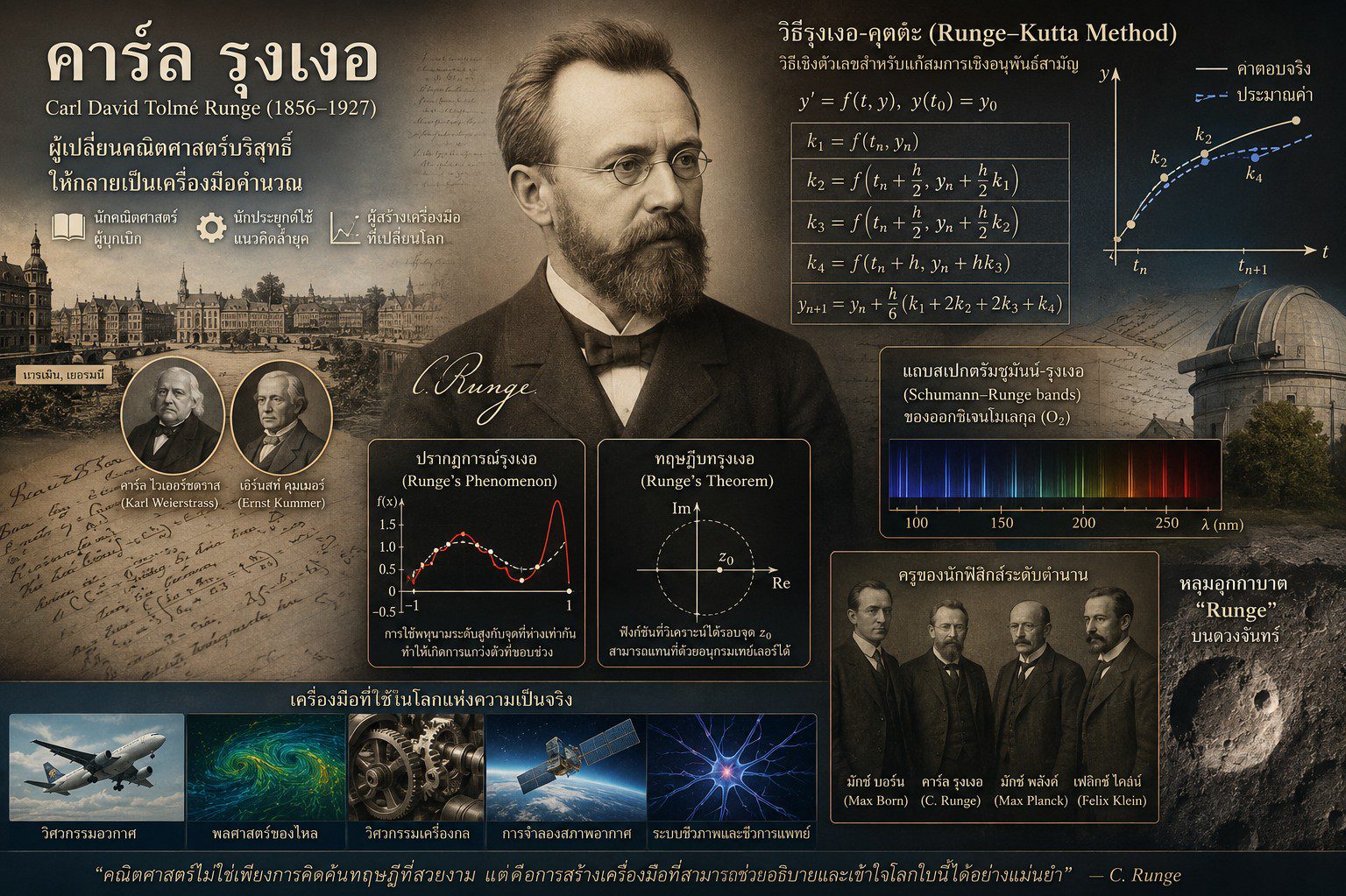
Rungner received a doctorate from the University of Berlin under the supervision of Karl Weierstrass and Ernst Kummer. In the early stages of his career, he worked in pure mathematics and felt as if he were at the center of the mathematical world, so he was almost in no rush to publish his work. It was only after visiting Mittag-Leffler in Stockholm for two weeks in 1884 that his work began to be published continuously in the journal Acta Mathematica. In 1886, he was appointed as a professor at the Hanover Technical Institute, fulfilling his father Ayme's conditions, and he married Ayme in August 1887.
From Pure Mathematics to Applied Mathematics
At Hanover, Runge worked for as long as 18 years, and it was during this time that the direction of his research completely changed, from pure mathematics to what he called 'applied mathematics,' which emphasized the accuracy of data and practical data management. This perspective differed from that of most of his colleagues at the time, who believed that mathematical models should only come from the real world, and that the mathematical methods used in technology at that time were already sufficient. It was this forward-thinking idea that caused Runge not to receive the academic positions he deserved until the later stage of his career.
The Origin of the Rung Ngo-Kutta Method
Rungner's most famous work is the co-development of the Runge-Kutta method with Martin Wilhelm Kutta, which is a numerical method used to solve ordinary differential equations. This method works by estimating the solution of a differential equation step by step, through calculating approximate slopes at multiple points within each time interval, and then combining them in a weighted manner to achieve a more accurate estimate than the traditional Euler method.
The Runge-Kutta method has become one of the most fundamental tools in numerical mathematics (numerical methods) because many differential equations in the real world cannot be solved using analytical methods. This method has therefore become an indispensable tool for simulating various dynamic systems, from mechanical engineering, fluid dynamics, aerospace engineering to weather and biological system simulations. It remains one of the most widely used algorithms in scientific and engineering computational software around the world to this day.
Other various works
Besides the Runge-Kutta method, he also has other important works that bear his name, such as Runge’s phenomenon, which describes the unwanted oscillation problem that occurs when using high-degree polynomials to approximate function values at equally spaced points, and Runge’s theorem in complex analysis. In addition, he made significant contributions to spectroscopy, geology, and astrophysics, especially the Schumann-Runge bands of molecular oxygen, which are named after him along with Victor Schumann.
The teacher of a legendary physicist
In 1904, with the influence of Max Planck and Felix Klein, Runge became the head of the mathematics department at the University of Göttingen. As the first and only person to hold the position in the field he pioneered, he worked there until retirement in 1925. His doctoral students included Max Born, who later won the Nobel Prize in Physics. Additionally, his daughter, Iris Runge, also became a mathematician, while his son, Wilhelm Runge, was one of the pioneers of early radar technology. Another daughter married the famous mathematician Richard Courant.
Carl Runge passed away on January 3, 1927, in Göttingen at the age of 70. In his honor, a crater on the Moon was named 'Runge.' His academic legacy, especially the Runge-Kutta method, remains a fundamental tool that scientists and engineers around the world use every day even today. It’s proof that a vision that values applying mathematics in practical ways can profoundly change the world, even if it wasn’t immediately recognized in his own time.