Karl Stormer: Norwegian mathematician who solved the northern lights puzzle with numbers
When it comes to scientists who work at the intersection of pure mathematics and the breathtaking natural phenomenon of the aurora, few do not think of Carl Størmer, a Norwegian mathematician and astrophysicist who made significant contributions both to pure number theory and to the study of the motion of charged particles in the Earth's magnetic field.
Early life and education
Carl Størmer's full name was Fredrik Carl Mülertz Størmer. He was born on September 3, 1874, in the city of Skien, Norway. He was the only child of Georg Ludvig Størmer, the town's pharmacist, and Elisabeth Amalie Johanne Henriette Mülertz. In his childhood, he had a wide interest in various natural sciences, including astronomy, physics, chemistry, meteorology, geology, and especially botany, before at around the age of sixteen, his interest turned fully towards pure mathematics.
He enrolled at the University of Christiania (the former name of the University of Oslo) in 1892 and graduated with a degree equivalent to a doctorate in 1897. During that time, he published his first mathematical article at the age of only 18, concerning trigonometric series generally derived from the Taylor expansion of the arcsine function. Then, from 1898 to 1900, he traveled to study at the Sorbonne University in Paris under the supervision of several legendary mathematicians, including Émile Picard, Henri Poincaré, Camille Jordan, Gaston Darboux, and Édouard Goursat.
Størmer's theorem and the rational number problem of pi
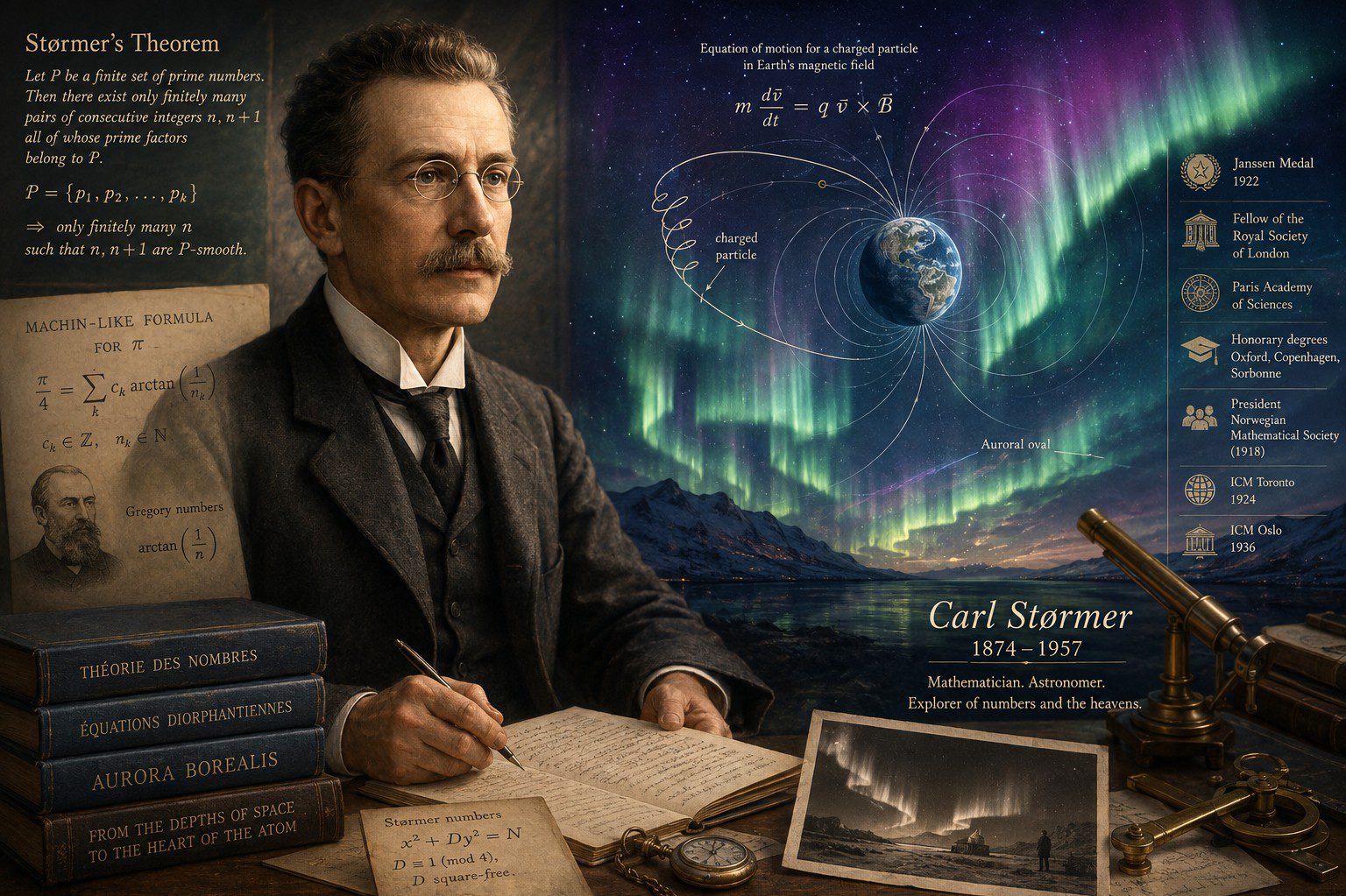
The work that made Størmer’s name most recognized in the field of number theory is Størmer’s theorem, which he proved in 1897. This theorem states that if a finite set of prime numbers P is given, there are only finitely many pairs of consecutive integers whose prime factors consist entirely of primes from the set P, also known as 'smooth numbers.' This theorem is considered a fundamental basis for the study of smooth numbers in modern number theory.
Størmer's interest in this theorem stemmed from his research on representing pi (π) as a linear sum of 'Gregory numbers,' which take the form arctan(1/n), also known as Machin-like formulas. At a time when the calculated decimal places of pi had not reached 600 digits, finding formulas that efficiently computed pi was very important. One of the mathematical features that Størmer discovered in 1896 continued to be applied in practice more than a century later, when Yasumasa Kanada's team used it to calculate pi to 1.24 trillion digits in 2002.
In addition, there is something called 'Størmer numbers,' which are related to the solutions of quadratic Diophantine equations and also play an important role in proving Fermat's Two Squares Theorem.
From Pure Mathematics to the Night Sky
A turning point in Stormer's career came when he was appointed as a professor of mathematics in Kristiania (the former name of Oslo) in 1903, and he began to turn his attention to challenging problems in physics, namely explaining the motion of charged particles in the Earth's magnetic field, which is the mechanism behind the aurora borealis.
Størmer devised precise mathematical methods and photography techniques to calculate the height and shape of various auroras, collecting continuous data over many solar cycles. His theoretical work on the trajectories of charged particles from the sun in Earth's magnetic field was astonishingly confirmed later when James Van Allen discovered the Van Allen Radiation Belts, which closely matched Størmer's analyses. He compiled this research in a book. From the Depths of Space to the Heart of the Atom
Honor and role in the field of science
Stormer received many honors throughout his career. He was elected as a member of the Royal Society of London and the Paris Academy of Sciences, as well as receiving honorary degrees from the universities of Oxford, Copenhagen, and Sorbonne. In 1922, he received the Janssen Medal from the Paris Academy of Sciences, and in 1918, he was also elected as the first president of the newly established Norwegian Mathematical Society.
In the international conference field, he was invited to lecture at the International Congress of Mathematicians in Toronto in 1924 on research regarding the northern lights, and in 1936 he also served as the president of the International Congress of Mathematicians held in Oslo.
The final stage of life and the legacy left behind
Carl Størmer passed away on August 13, 1957, in Oslo at the age of 82. His entire career reflected a rare ability to connect pure mathematics with complex natural phenomena. Today, his name has been used to name a crater on the far side of the moon (Störmer crater) in honor of his work in astronomy and space physics.
From a boy fascinated by botany to becoming a mathematician who discovered an important theorem in number theory, and ultimately becoming a pioneer in understanding the aurora through physical equations, Carl Stormer is an outstanding example of a scientist who refused to limit himself to just one field of study.